
Power Factor Correction for Industrial and Commercial Facilities
Power factor correction is a core discipline for modern industrial power systems and commercial electrical facilities that rely on stable, efficient energy to keep production running. In every plant or large building, the electrical network must deliver real power to useful loads while also managing current associated with reactive power. When that balance is poor, cables and transformers carry unnecessary current, losses increase, and equipment life shortens. A structured programme of PF optimisation turns the electrical system into a controllable asset instead of an unpredictable cost centre and lays the foundation for long-term reliability and growth.
In practice, many facilities now operate with a high share of nonlinear loads, which draw current in pulses instead of smooth sine waves. Drives, rectifiers, data-centre power supplies, and electronic lighting introduce both poor displacement PF and significant harmonic distortion. The combination produces extra heat, audible noise, and voltage drop throughout the network, especially where cables run long distances or distribution equipment is already heavily loaded. Without targeted PF ngineering, these effects quietly erode performance while utility invoices and maintenance costs steadily climb.
To address these issues, our engineers at Smart Power Solutions analyse how your plant actually uses electricity before recommending any specific hardware. Rather than treating PF as a generic checkbox item, we integrate it into a broader energy optimization strategy that considers safety, uptime, expansion plans, and the true cost of downtime. The result is a solution that fits real operating conditions instead of forcing your facility to work around a one-size-fits-all installation.
Understanding Power Factor Correction Benefits
When we speak about power factor correction benefits, the first thing most clients think about is utility savings. Many Ontario utilities apply penalties when the PF falls below a specified threshold, effectively charging for kVA instead of kW. By raising the PF into the recommended range, those penalties disappear and the same production output requires less apparent power from the grid. That alone can justify a well-engineered PF project, particularly for energy-intensive sites.
However, the advantages go far beyond lower bills. Improving PF reduces current in feeders and switchgear, which immediately cuts I²R losses and temperature rise. Better PF therefore supports measurable electrical efficiency for the entire facility. Motors run cooler, insulation degradation slows, and sensitive control equipment experiences fewer unexplained trips. These gains are often invisible in daily operation, yet they accumulate into major lifecycle savings and fewer disruptive failures.
Another key outcome is improved voltage stability. Excess reactive current causes voltage drop across long runs of cable and bus duct, making it harder for motors and drives at the end of the line to start reliably. Once PF is corrected, voltage profiles flatten and torque at motor terminals increases. Operators notice fewer brown-out conditions, better product quality, and smoother equipment start-ups even during heavy production peaks or seasonal loading changes.
From Measurements to Power Factor Correction Systems
Every project begins with detailed electrical diagnostics to ensure that the eventual design is based on facts rather than assumptions. We connect power-quality loggers to capture multi-day data on current, voltage, demand peaks, transformer loading, and phase balance. This information feeds a rigorous power quality analysis that reveals when and where the network is stressed, how strongly drives and other VFD applications are influencing the waveform, and which feeders require the most urgent attention.
Using those measurements, we design tailored power factor correction systems that match both the electrical profile of the facility and its operational constraints. Some sites benefit from centralised solutions near the main switchboard, while others require distributed correction closer to major loads. Where processes are highly dynamic, we prioritise response speed and control sophistication; where they are steady, we focus on robustness and simplicity. In all cases, the design is documented in clear single-line diagrams and supported by training so your team can operate it with confidence.
Many of the most demanding customers operate complex industrial automation power systems with networks of PLCs, drives, and communication cabling. In these environments, compatiblity with control equipment is essential. We therefore evaluate how each PF solution will interact with existing drives, PLC I/O, and safety systems before any hardware is ordered. That proactive engineering avoids unpleasant surprises during commissioning and ensures that correction supports — rather than disrupts — roduction.
Managing Harmonics and Standards Compliance
Because nonlinear devices draw current in pulses, they generate voltage distortion that can stress capacitors and transformers. To manage this, we integrate harmonic filters and carefully tuned equipment so that PF improvements do not create resonance or other unintended issues. For heavily distorted networks, detuned capacitor banks are often the most reliable option, as their series reactors shift the resonance point away from critical harmonic frequencies.
Our designs are guided by IEEE 519 compliance recommendations, local utility rules, and relevant Canadian and IEC standards. By benchmarking measured distortion against these limits we can determine whether simple correction will suffice or whether deeper mitigation is required. Where harmonics are modest, conventional capacitor banks can provide excellent performance; where they are severe, a combination of detuning and filtering is used so that the PF solution contributes to cleaner waveforms rather than merely hiding the symptoms of distortion.
Ultimately, well-managed harmonics contribute directly to distribution network reliability. Transformers run cooler, protective devices operate predictably, and sensitive electronics remain within their design envelopes. When harmonics are left unmanaged, even a correctly sized capacitor installation can suffer unexplained failures. Our goal is to ensure that each project enhances overall power-system health instead of simply satisfying a penalty clause on a utility bill.
Choosing and Applying Automatic Capacitor Banks
For many plants, the most practical solution is to install automatic capacitor banks that track PF in real time and add or remove reactive compensation in discrete steps. These systems use intelligent controllers to monitor kW, kVAR, and kVA, then switch combinations of stages so the PF remains within a chosen range even as production levels change. Operators no longer need to manually switch banks, and the risk of over-correction during light-load periods is significantly reduced.
Where distortion is higher or sensitive drives are present, we may combine switching with detuned capacitor banks that use reactors to create a safer impedance profile. This improves electrical infrastructure reliability by shielding capacitors and upstream gear from excessive harmonic currents. When combined with strategically placed harmonic filters, the result is a system that controls both displacement PF and waveform quality, providing stable conditions for everything from large motors to delicate instrumentation.
In facilities expecting future growth, we design banks with spare physical space and controller capacity to allow additional stages later. That flexibility supports long-term operational continuity and makes each project a stepping stone toward a more resilient network rather than a static, one-off installation.
Integration with Energy and Reliability Strategy
A modern PF programme is also a strategic lever for Power Factor Efficiency Improvement across the business. By reclaiming kVA capacity, organisations can connect new machinery or HVAC equipment without immediately upgrading incoming service. The same transformers and cables carry more useful work, and losses are lower at every loading point. When combined with lighting retrofits and drive optimisation, PF improvements become a visible part of an integrated energy-management roadmap rather than a hidden technical detail.
From an asset-management perspective, PF projects contribute to overall Power Factor Improvement for motors, transformers, and switchgear fleets. Lower currents reduce mechanical stress on breaker mechanisms, easing wear and tear on moving parts. Transformers see smoother thermal profiles, which extends insulation life and postpones costly replacements. Over years of continuous operation, these seemingly minor improvements add up to major savings in avoided failures and capital deferrals.
Because we treat PF as a continuous process rather than a one-time event, every project includes a plan for ongoing Power Factor Assessment. By trending measurements over months and years, your team can see how network behaviour evolves as production lines change, new drives appear, or additional buildings are added. That data makes it easier to justify incremental investments and to schedule upgrades before problems become urgent.
Repair, Restoration, and Modernisation of Existing Equipment
Many facilities already have banks in place, but age and changing production patterns mean these systems no longer operate as intended. For smaller issues, targeted Capacitor Repair may be all that is required: replacing failed cans, damaged resistors, or worn contactors while leaving the rest of the installation intact. This approach restores capacity quickly and economically, minimising downtime and making best use of existing hardware.
When damage is more extensive or design limitations become clear, we may recommend comprehensive Capacitor Bank Repair that addresses wiring, enclosure condition, control schemes, and protection. In still more challenging cases, full Capacitor Bank Restoration is the safest route. That process may involve building new panels that reuse healthy busbars and cabling while bringing the overall assembly up to current safety and performance expectations.
To keep assets dependable over the long term, many customers choose structured Capacitor Bank Maintenance and Repair agreements. Our technicians perform periodic inspections, thermal imaging, torque checks, and functional testing tailored to each site’s criticality. Findings are documented in clear reports that support Power Factor Correction System Inspection and Diagnostics and help prioritise maintenance budgets where they will deliver the greatest risk reduction.
Specialised Services for Complex Facilities
Occasionally, a bank has deteriorated beyond the point where upgrades are economical. In these situations we design and deliver a complete Power Factor Correction System Repair package. That may include new modular enclosures, modern controllers with communication capability, detuned stages for problematic feeders, and improvements to ventilation and segregation. Throughout the process we coordinate with operations teams so that shutdown time is minimised and commissioning aligns with production schedules.
For multi-site industrial groups and property portfolios, we extend these services into fleet-level Power Factor Performance Assessment. By comparing PF trends, losses, and penalty charges across locations, we can identify sites where small investments will produce large savings. The same analysis highlights plants where more advanced PF projects should be integrated into broader reliability programmes or capital expansions, ensuring that engineering resources are focused where they create the most value.
In all of this work, we pay close attention to electrical infrastructure reliability. Correcting PF is never allowed to compromise fault-level ratings, clearances, or safety procedures. Instead, each change is tested against coordination studies and protection settings so that the overall system remains robust under both normal and fault conditions. Our aim is always a network that quietly supports production rather than one that demands constant intervention.
Addressing Nonlinear Loads and Advanced Applications
Many modern plants are dominated by drive-based processes and other VFD applications. These loads present unique challenges: they can rapidly change demand, inject distortion, and interact with capacitors in unexpected ways. Our engineers take time to understand how each group of drives is controlled, what ramp profiles look like, and how they are clustered around shared feeders so that PF equipment can be applied safely and effectively.
In particularly demanding applications, we sometimes deploy hybrid solutions that combine static banks with active filtering technology. These solutions offer fast response, precise control of reactive current, and additional harmonic mitigation. Because of their sophistication, such systems are generally reserved for high-value equipment or processes where downtime costs are exceptionally high. When appropriate, we integrate them with existing SCADA or building-management platforms so that their status can be monitored alongside other critical infrastructure.
Where multiple technologies coexist, we pay careful attention to how PF projects influence broader distribution network reliability and performance. Modelling tools help us predict how new banks will affect fault levels, transformer loading, and protective-device coordination. That analysis is particularly important for sites planning expansions, because it allows corrective actions to be built into the design before construction begins.
Regional Context and Local Experience
Our team has extensive experience with projects classified under power factor correction toronto and across the rest of Ontario. Working within local utility frameworks, inspection regimes, and construction practices means we understand not only the technical requirements but also the practical constraints that influence project success. We know how outages must be scheduled, which documentation inspectors expect to see, and how to coordinate PF upgrades with other electrical work to minimise disruption.
Because we view PF as part of a long-term partnership rather than a single sale, we maintain open communication with plant and facility teams. Training sessions, debrief meetings, and written guides ensure that everyone understands how new banks operate and what warning signs to watch for. When clients adopt this mindset, PF becomes an integral element of their operational continuity planning, protecting productivity just as much as it protects the bottom line.
Why Work with Smart Power Solutions
Choosing the right partner is critical when investing in PF equipment and services. Our engineers combine theoretical expertise with hands-on commissioning experience, allowing us to translate complex power concepts into clear, actionable steps. Whether the requirement is a small retrofit or a large-scale campus project, we bring the same disciplined process, from initial Power Factor Correction System Inspection and Diagnostics through design, construction, and final verification.
We also remain engaged after commissioning, offering troubleshooting support and follow-up reviews so that PF installations continue to perform as expected. As your facility evolves, we can update models, adjust settings, or plan new stages of correction to keep pace with growth. Over time, this creates a living PF roadmap that evolves alongside your assets rather than lagging behind them.
Ultimately, our goal is to help clients treat PF not as a narrow technical problem but as a strategic tool. By integrating correction with broader energy-management initiatives, reliability programmes, and risk-reduction efforts, we enable organisations to extract maximum value from every kilovolt-ampere they purchase. The result is a safer, more efficient, and more resilient electrical environment that supports the business today and is ready for tomorrow’s challenges.

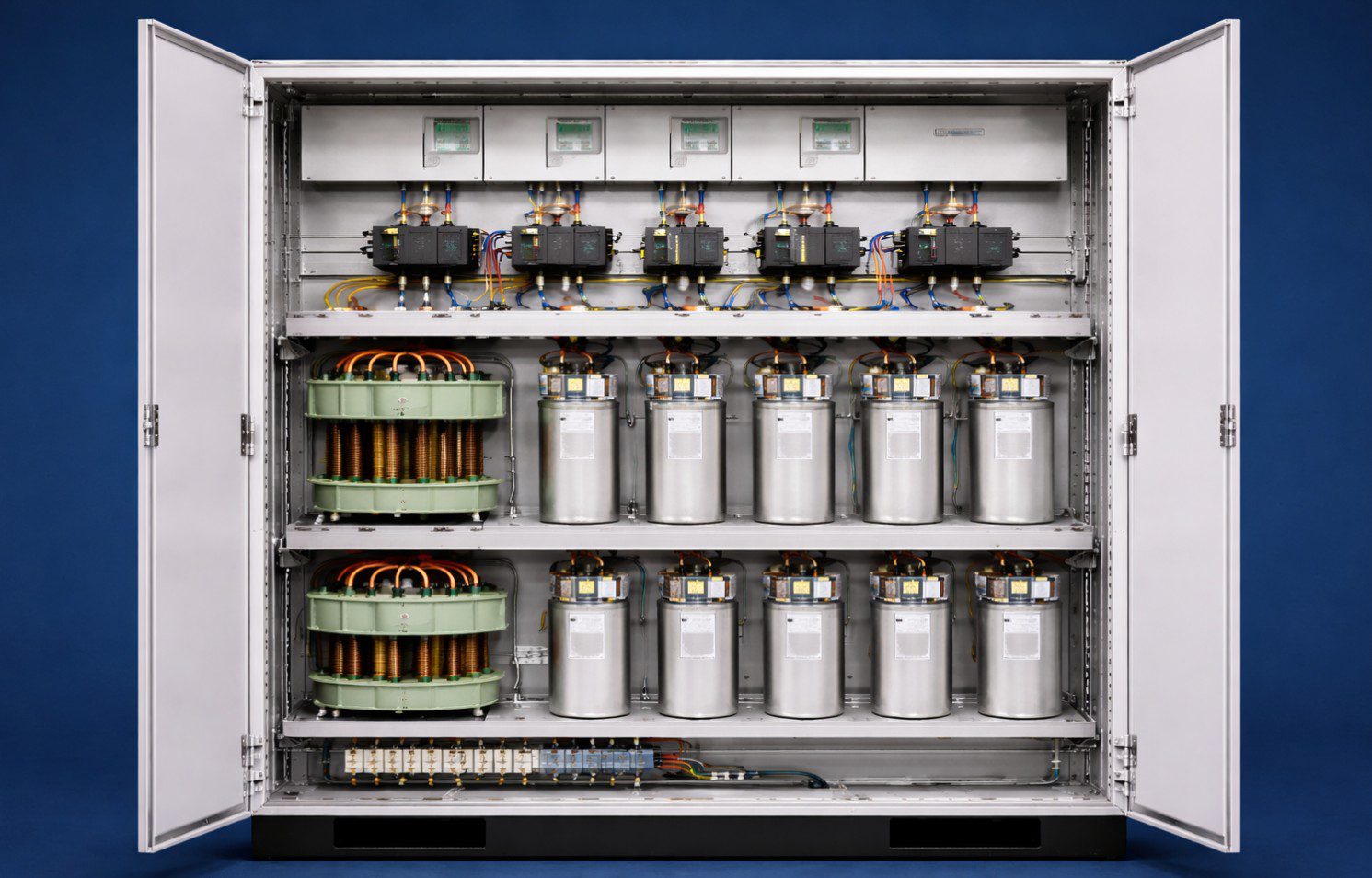
Advanced Power Factor Engineering Modules
Harmonic Risk
Analysis
Resonance screening, impedance evaluation, and IEEE 519-based capacitor safety review.
High-Speed Dynamic
PF Control
Rapid-response capacitor systems for variable industrial loads.
Detuned Capacitor
Bank Design
Reactor-integrated banks engineered for harmonic-rich networks.
PF System Retrofit
& Modernization
Upgrading aging capacitor banks for reliability and compliance.
Utility Compliance
& Verification
Measured PF improvement, kVA optimization, and documented performance proof.
Contact Us
To get a quote
To get a solution
To ask a technical question