
Load Profile Monitoring Ontario: Demand Peaks, kVA Loading & Operational Correlation
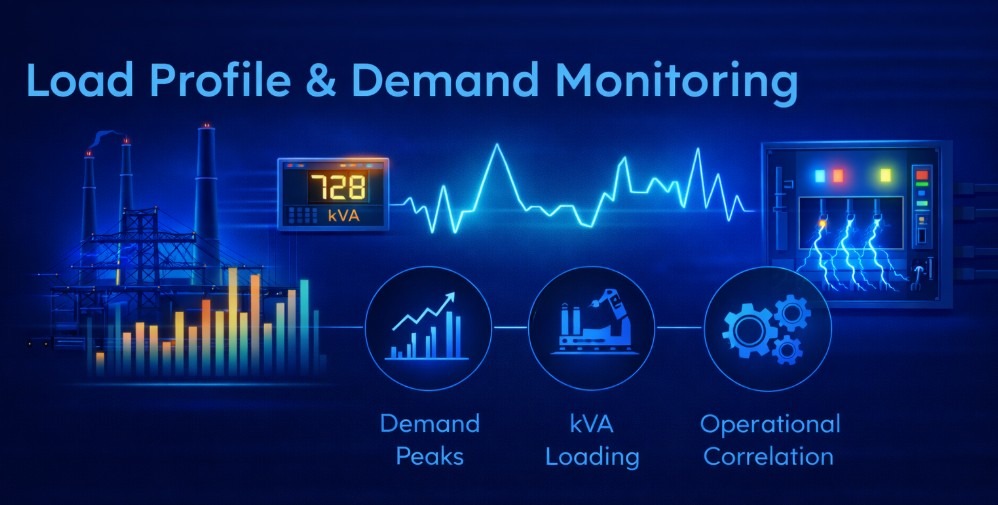
Load profile monitoring Ontario is the fastest way to turn “high bills” into hard, time-stamped facts: when peaks happen, what equipment creates them, and which operational overlaps inflate demand charges. For industrial facilities, the load profile is not a theory—it is the electrical fingerprint of your production schedule, compressed air cycles, HVAC behavior, material handling, and the real-world way your plant draws power from the grid.
Many Ontario sites track only monthly kWh and miss the real cost driver: short peak intervals that define the billing demand. That’s why demand monitoring industrial Ontario is a core diagnostic module for any facility trying to control costs without cutting production. When you combine interval data with equipment correlation, you get a clear path to utility demand charge optimization, smarter capacity planning, and fewer electrical “mystery” issues.
This page explains how an industrial energy load analysis is performed, what you should measure, how to interpret demand and kVA behavior, and how to build a practical plan for peak demand reduction Ontario that your team can actually implement.
Related services (internal links):
- Power Quality Diagnostics & Testing
- Energy Efficiency Audit
- Power Factor Correction
- Thermal Infrared Electrical Audit
- Contact
What Is a Load Profile (and Why It Changes Your Bill)
A load profile is a time-based record of how your facility draws electrical power across a day, a shift, a week, and a full production cycle. It typically includes kW demand, kVA demand, current, voltage, and (when needed) power factor and harmonics indicators. When captured correctly, industrial power consumption monitoring reveals the difference between:
- Base load: the minimum demand your site draws even when production is low
- Process load: predictable increases tied to production equipment and schedules
- Peak events: short spikes caused by overlapping starts, simultaneous batches, compressors, ovens, chillers, or large drives
- Hidden peaks: brief demand surges that happen between manual checks and never appear on simple monthly summaries
In Ontario, many industrial bills include a demand component that is determined by the highest measured demand interval during the billing period. A single “bad” overlap—like a compressor start at the same time as a VFD ramp, plus an oven cycle—can create the monthly maximum. The result is a higher bill even if total kWh does not rise.
Why Demand Monitoring Industrial Ontario Matters
Demand monitoring industrial Ontario matters because industrial electrical costs are shaped by time, not just totals. Facilities often invest in efficiency projects and still see high bills because they never addressed when demand peaks occur. A proper monitoring program allows you to:
- Identify which processes contribute most to the monthly maximum demand
- Separate “normal production load” from abnormal overlaps and control issues
- Quantify how kVA demand behaves under different operating modes
- Build a realistic plan for peak demand reduction Ontario without risking uptime
- Validate changes with before/after interval evidence
In many plants, demand peaks are caused less by one big machine and more by timing: multiple systems starting together, cycling patterns, or automated sequences that unintentionally overlap.
kW vs kVA: Why kVA Demand Analysis Ontario Is Often the Missing Piece
Most teams understand kW (real power) because it feels like “actual work.” But many industrial billing and capacity issues are driven by kVA (apparent power). That’s why kVA demand analysis Ontario is a crucial part of any load profile assessment.
kVA rises when reactive power increases. Common contributors include:
- Large induction motors under light load
- Transformer magnetizing current
- Under-compensated reactive demand
- System resonance and capacitor interaction issues (in some sites)
- Harmonic-related apparent demand inflation in sensitive setups
When kVA demand is the driver, your best fix might not be “use less energy,” but “improve power factor behavior at the right times.” That’s when your findings connect directly to Power Factor Correction.
Electrical Load Study Ontario: What a Professional Study Includes
An electrical load study Ontario is not just “put a meter on the main.” A decision-grade study is structured to answer:
- What is the true base load, and what creates it?
- Which equipment clusters create peak demand intervals?
- Is demand driven by kW, kVA, or both?
- How does demand correlate with operations and scheduling?
- What changes provide the best ROI and lowest risk?
Typical measurement approach:
- Service entrance monitoring to capture site-wide demand behavior and align with billing demand intervals
- Sub-distribution monitoring to identify which feeders or departments drive peaks
- Targeted equipment correlation for major contributors (compressors, chillers, ovens, welders, large drives, pumps)
- Voltage/current event awareness if the site also experiences nuisance faults, trips, or process instability
If you suspect that disturbances are occurring alongside peaks (trips, faults, control resets), combine the study with Power Quality Diagnostics Ontario to avoid treating two problems as one.
Industrial Energy Load Analysis: Turning Data Into Actions
Industrial energy load analysis is the step where monitoring becomes operational strategy. Raw charts are not enough; the point is to produce a plan that maintenance, engineering, and operations can execute.
We focus on:
- Peak window identification: what day/time/shift creates the monthly max
- Overlap mapping: which systems are simultaneously active at peak moments
- Control sequence review: automated behaviors that unintentionally stack load
- kVA vs kW causality: whether reactive demand inflates the peak
- Operational correlation: linking electrical peaks to batch steps, CIP cycles, startups, changeovers, and compressed air behavior
The result is a ranked list of actions with measurable impact potential—not generic advice.
Peak Demand Reduction Ontario: What Works Without Hurting Production
Peak demand reduction Ontario is best achieved through low-risk operational and control improvements before expensive equipment changes. Common high-value strategies include:
1) Sequencing and Staggering Starts
Many peaks are created when multiple large loads start together. Staggering compressor starts, pump sequencing, or scheduling high-heat loads away from shift start can reduce the monthly maximum without changing production output.
2) Compressor and Compressed Air Optimization
Compressed air is a common demand driver. Poor control tuning, aggressive pressure bands, or multiple compressors fighting each other can create repeated peaks. Monitoring reveals whether compressors are creating the demand maximum and how frequently those events occur.
3) VFD Ramp and Control Tuning
Drive ramp behavior can create high demand intervals if acceleration is too aggressive, especially when several drives ramp at once. Adjustments can smooth demand without slowing process requirements.
4) Demand-Based Scheduling for Batch Processes
Ovens, heaters, and batch cycles often stack load. Scheduling a high-demand batch start 10–20 minutes later can prevent overlap with other cyclical loads.
5) Power Factor Behavior at Peak Times
If kVA is inflating the demand peak, improving reactive compensation at the right moments may reduce billed demand. This is where findings connect to Power Factor Correction.
Utility Demand Charge Optimization: How to Build a Defensible Plan
Utility demand charge optimization should be evidence-driven and defensible. That means your plan should specify:
- What interval creates the monthly maximum demand
- Which equipment contributes most during that interval
- Which operational changes reduce overlap without harming output
- Which electrical improvements reduce kVA inflation when applicable
- How success will be verified (before/after monitoring)
In many cases, the “best” solution is not the most complex. A simple timing adjustment can deliver better savings than costly hardware if peaks are overlap-driven.
How Load Monitoring Connects to Power Quality Diagnostics Ontario
Load behavior and power quality issues often interact. High-demand events can coincide with voltage fluctuations, equipment trips, or protective device stress. If your site experiences process instability or unexplained equipment behavior during high-load periods, integrate the findings with power quality diagnostics Ontario to confirm whether electrical disturbances are involved.
Service link: Power Quality Diagnostics & Testing
Thermal Risk and Equipment Stress During Peaks
Demand peaks can increase thermal stress at terminations, breaker contacts, bus connections, and transformers. If your load profile shows repeated high peaks, it may be worth verifying whether critical electrical points are running hotter than expected under those conditions. That’s where Thermal Infrared Electrical Audit provides a practical confirmation.
Thermal findings can help prioritize corrective maintenance and reduce risk before it becomes downtime.
Energy Efficiency Audit Ontario: When Load Profiles Reveal Bigger Savings
A well-captured load profile often reveals more than peaks. It can expose:
- High base load outside production hours
- Oversized motors running lightly loaded
- Systems cycling unnecessarily
- Uncontrolled ventilation and heating loads
- Equipment running during idle periods
These are direct inputs into an energy efficiency audit Ontario because they identify waste patterns, not guesses. Service link: Energy Efficiency Audit
What You Should Receive (Deliverables)
A proper study should produce management-ready outputs—not just screenshots. Typical deliverables include:
- Load profile charts by day/shift with peak intervals highlighted
- kW vs kVA comparison and explanation of what drives billed demand
- Base load assessment and idle-time opportunities
- Operational correlation notes (what happened during peaks)
- Ranked actions for peak reduction with expected impact
- Verification plan to confirm savings after changes
External Reference
For general background on measuring electric power quantities and interpreting kW/kVA relationships, you can review the IEEE overview resources here:
FAQ (10 Questions)
1) How long should monitoring run to be reliable?
Most industrial sites need 7–14 days to cover normal cycles, weekends, and at least one full production pattern.
2) What interval matters most for billing demand?
Demand billing typically depends on the highest interval in the billing period. Your monitoring should align interval logging with how demand is calculated.
3) Why is kVA demand sometimes higher than expected?
Reactive power and system conditions can inflate kVA. That’s why kVA demand analysis Ontario is included in the study.
4) Can I reduce peaks without new equipment?
Often yes—sequencing, timing changes, compressor control tuning, and ramp adjustments can reduce peak overlap.
5) How do I know which equipment causes peaks?
By combining service entrance data with sub-panel monitoring and operational logs to build causality, not assumptions.
6) Is load monitoring the same as power quality diagnostics?
No. Load monitoring focuses on demand behavior; power quality diagnostics focuses on disturbances, events, and waveform-related problems. They can be combined when needed.
7) Does power factor correction always reduce demand charges?
Only when kVA demand is a significant driver. Monitoring determines whether correction will meaningfully impact billed demand.
8) Can thermal imaging help with demand issues?
Thermal imaging validates whether peaks create overheating at critical connections. See Thermal Infrared Electrical Audit.
9) What is the best “first win” for demand optimization?
Usually sequencing and overlap reduction—small timing changes can stop a monthly maximum demand from occurring.
10) How do you confirm the solution worked?
With verification monitoring that shows the peak interval is reduced and does not reappear under normal production conditions.
Next Steps
If you want a decision-grade plan for industrial power consumption monitoring, peak control, and cost reduction, start with a structured assessment and evidence-based recommendations.
Start here: Contact Smart Power Solutions
Contact Us
To get a quote
To get a solution
To ask a technical question