
Harmonic Risk Analysis Before Capacitor Installation
Modern industrial and commercial electrical systems across Ontario are increasingly dominated by nonlinear loads such as variable frequency drives (VFDs), rectifiers, UPS systems, LED lighting, robotics, data centre infrastructure, and automated production equipment. While these technologies improve operational efficiency, they introduce harmonic distortion that fundamentally changes how Power Factor Correction systems must be engineered.
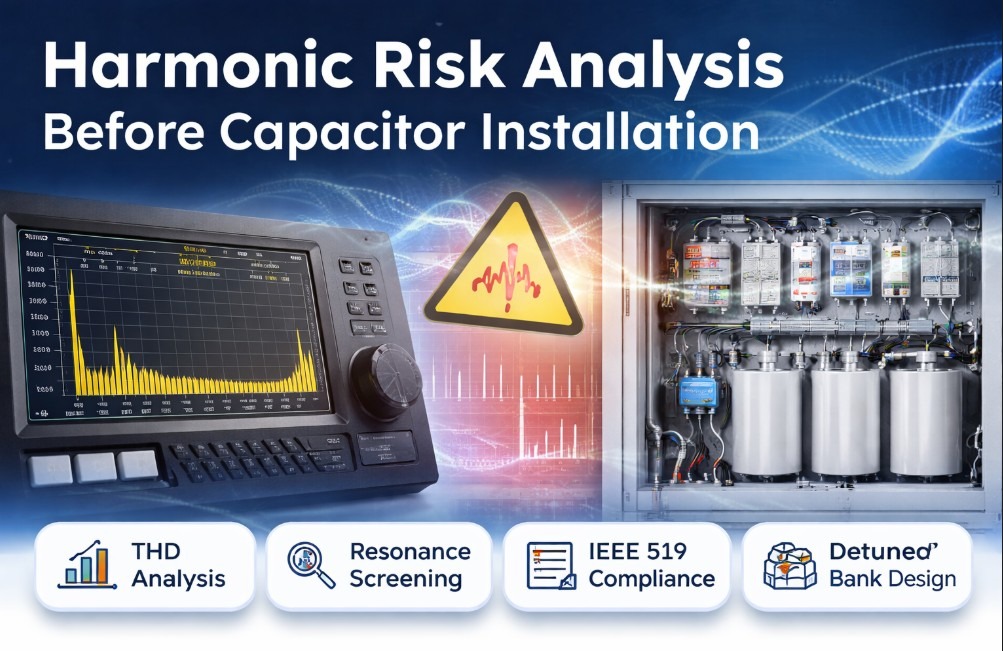
A structured harmonic risk analysis is therefore not optional — it is the engineering foundation of safe and effective Power Factor Correction. Installing capacitor banks without proper harmonic evaluation can create resonance, amplify distortion, overheat infrastructure, and reduce equipment lifespan.
At Smart Power Solutions, we deliver measurement-driven engineering that ensures capacitor systems improve efficiency without introducing hidden electrical risk.
The Reality of Harmonic Distortion in Ontario Industrial Facilities
Harmonic distortion Ontario facilities experience today is significantly higher than in traditional linear systems. Nonlinear devices draw current in pulses rather than sinusoidal waveforms, generating harmonic components at multiples of 60 Hz. Dominant harmonic orders in industrial environments commonly include the 5th, 7th, 11th, and 13th, with higher-order components appearing depending on equipment type and switching behavior.
This is why nonlinear load harmonic analysis must be completed before specifying any compensation hardware.
Why Capacitor Banks Can Amplify Harmonics
Capacitors reduce impedance at higher frequencies. While this improves reactive power compensation, it can also attract harmonic currents. If a capacitor bank is installed without system impedance evaluation, it may create parallel resonance with transformer and feeder inductance.
Consequences may include:
• Amplified harmonic currents
• Capacitor overheating and premature failure
• Transformer temperature rise and derating risk
• Increased I²R losses in feeders and bus duct
• Nuisance breaker trips and unexplained process faults
• Accelerated switchgear insulation stress
This makes capacitor bank resonance analysis essential for safe and stable PFC design.
Measurement-Based Industrial Harmonic Assessment
Our industrial harmonic assessment begins with multi-day data logging under real operating conditions. Short snapshots are not enough because distortion varies with process cycles, shift changes, and demand peaks.
We capture:
• Total Harmonic Distortion (THD)
• Individual harmonic magnitudes (up to 50th and 63rd order where required)
• Total Demand Distortion (TDD)
• Phase imbalance and harmonic distribution
• Neutral conductor loading and triplen harmonic indicators
• Demand correlation (kW, kVAR, kVA) vs distortion behavior
This measurement dataset forms the basis of a defensible power factor correction harmonic study—designed around facts, not assumptions.
Resonance Screening Capacitor Bank Evaluation
Every electrical network has a natural resonant frequency determined by inductive and capacitive elements. Adding capacitor kVAR shifts that resonant point. If it moves into the range of strong harmonic orders (for example near the 5th or 7th), the risk of amplification increases sharply.
Our resonance screening capacitor bank process includes:
• Short-circuit strength evaluation at the point of connection
• Transformer impedance assessment and feeder characteristics review
• Estimated resonant frequency screening
• Harmonic order alignment risk analysis
• Practical engineering recommendations for safe implementation
Detuned Capacitor Bank Study and Mitigation Strategy
When harmonic levels exceed safe thresholds, we conduct a complete detuned capacitor bank study. Detuned banks use series reactors to shift resonance away from dominant harmonics, protecting capacitors and upstream equipment while maintaining reactive compensation performance.
Reactor selection and detuning targets are chosen based on your measured harmonic spectrum, network strength, and operating profile—not generic default selections.
IEEE 519 Evaluation Ontario Engineering Requirements
Standards-based benchmarking strengthens reliability and reduces capital risk. Our IEEE 519 evaluation Ontario process benchmarks measured distortion against recommended limits at the point of common coupling (PCC), considering system short-circuit ratio and demand behavior.
For reference, IEEE 519 guidance is published by IEEE and is widely used across North America for harmonic performance expectations:
IEEE 519 Standard Overview.
Where Class A measurement rigor is required for waveform evaluation and event-quality correlation, we also align methodology with IEC measurement practices such as IEC 61000-4-30:
IEC 61000-4-30 Publication.
This approach ensures your Power Factor Correction system is engineered with recognized best practices.
Impact on Transformers and Thermal Performance
Harmonic currents increase RMS loading and introduce additional losses that raise transformer temperature. Over time, this accelerates insulation aging and reduces asset life. Where thermal stress is suspected, we integrate findings from our Thermal Infrared Electrical Audit to validate real equipment condition under load.
Neutral Conductor and Grounding Considerations
Triplen harmonics (3rd, 9th, 15th) accumulate in neutral conductors in three-phase four-wire systems. Facilities with high single-phase nonlinear loads can experience unexpected neutral overheating and voltage reference instability.
Where grounding stability is a concern, harmonic analysis is coordinated with our Grounding System Audit to confirm safe bonding and reference conditions.
Integration with Power Quality Engineering Ontario Strategy
Effective power quality engineering Ontario requires an integrated approach. Harmonic stability improves the accuracy of disturbance investigations and demand optimization, especially when combined with Power Quality Diagnostics. Stable waveforms also support broader reliability initiatives and reduce false conclusions during troubleshooting.
Financial and Operational Risk of Skipping Harmonic Analysis
Ignoring harmonic distortion during capacitor installation can lead to premature capacitor failure, increased maintenance costs, transformer derating, nuisance trips, and lost production time. A structured harmonic risk analysis protects infrastructure, reduces lifecycle cost, and strengthens the long-term ROI of your PFC investment.
Engineering Confidence Before Capital Investment
Every capacitor bank installation should begin with a comprehensive power factor correction harmonic study that includes resonance modeling, compliance benchmarking, and thermal risk validation.
Schedule your harmonic distortion evaluation today through Smart Power Solutions and ensure your capacitor bank performs safely under real operating conditions.
Contact Us
To get a quote
To get a solution
To ask a technical question