
Power Quality Diagnostics
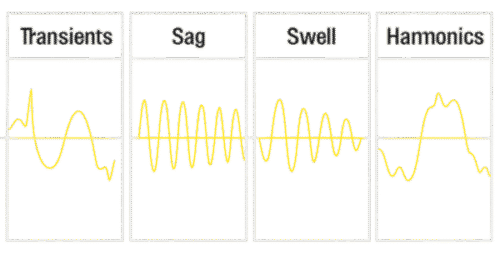
Power quality testing is the essential first step in uncovering hidden electrical problems that silently undermine the reliability of modern industrial and commercial facilities. Power quality (PQ) disturbances — voltage sags, swells, transients, and harmonic distortion — are the unseen enemies that damage sensitive electronics, reduce equipment lifespan, trigger unexpected downtime, and inflate your maintenance budget.
Through advanced power quality diagnostics methods and professional power quality testing, Smart Power Solutions replaces guesswork with rigorous, data-driven analysis. Our audit provides a comprehensive roadmap that transforms system instability into predictable, verified operational reliability and measurable savings for your facility.
I. Methodology: Certified Class A Power Quality Testing & Diagnostics Precision
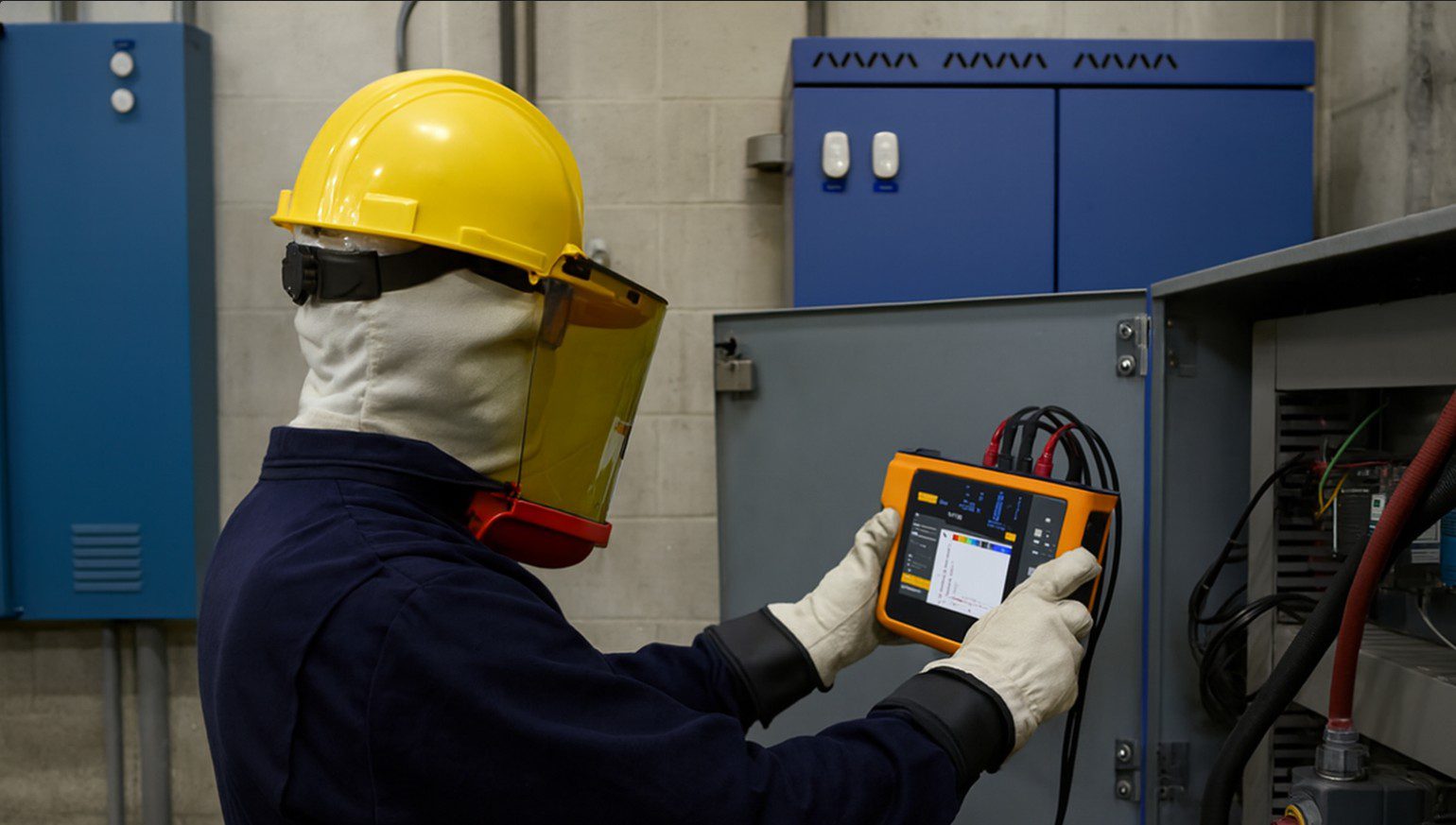
A reliable PQ diagnosis demands certified, high-precision equipment and expert interpretation. Our power quality testing strictly adheres to the international standard IEC 61000-4-30 Class A by using the Fluke 1777 Three-Phase Power Quality Analyzer. This compliance ensures the accuracy, traceability, and comparability of every measurement. For facilities that require additional diagnostics depth, we often complement this analysis with advanced thermal imaging inspections to identify heat-driven electrical faults invisible to standard instrumentation.
The Three Phases of Our Power Quality Testing Audit:
- Continuous Monitoring & Data Capture: We deploy the Fluke 1777 for a minimum of 7 days at critical points—main service entrance, key switchgear, and specific load centers. This long-duration capture is essential for identifying intermittent and load-dependent phenomena that shorter tests miss.
- Harmonic Analysis & Load Profile Mapping: We perform detailed analysis of current and voltage waveforms, calculating key metrics like Total Harmonic Distortion (THD) to ensure compliance with IEEE 519 harmonic standards.
- Comprehensive Reporting & Mitigation Strategy: The final report translates complex data into clear, actionable recommendations, including a detailed Return on Investment (ROI) projection for solutions such as Active Harmonic Filters. Our remediation recommendations connect directly with the solutions described on our Power Quality Solutions page.
II. Core Diagnostics Metrics & Technical Analysis
Our power quality testing focuses on quantifiable metrics that define the health and stability of your power system.
A. Harmonic Distortion (THD)
Non-linear loads (such as Variable Frequency Drives, LED lighting, and UPS systems) inject harmonic currents back into the system, causing voltage distortion, overheating, and stress on neutral conductors. We precisely measure THD for both voltage and current.
- Detailed Harmonic Analysis: Beyond the overall THD, the Fluke 1777 allows us to isolate individual harmonics (up to the 63rd order, exceeding typical IEEE 519 requirements of the 50th order) and interharmonics to identify the exact source and required mitigation. High 3rd order harmonics, for example, are common with single-phase electronic loads and often lead to dangerous neutral current overload in 4-wire systems.
- Mitigation Strategy: We specify solutions from line reactors and isolation transformers to high-efficiency Active Harmonic Filters (AHF) that actively cancel harmonic distortion and maintain strict adherence to IEEE 519 limits.
B. Voltage Sags, Swells, and Interruptions (Voltage Fluctuation)
These disturbances represent momentary deviations from the nominal voltage, leading to equipment tripping, contactor drops, and data loss. We analyze each event according to international standards (CBEMA and ITIC curves) as part of our power quality testing process.
- Sags (Dips): A momentary decrease in RMS voltage, which is the single most common power quality issue, often causing equipment to reset or shut down.
- Swells: A momentary increase in RMS voltage, which can stress and ultimately damage insulation and components.
- Interruptions: Complete loss of voltage for more than one cycle. Even momentary interruptions halt production and lead to significant data loss.
- Voltage Fluctuation & Flicker: We analyze rapid, sustained voltage changes that impact lighting quality (flicker) and stress internal regulating systems, measured against the EN 50160 standard.
C. Transients (Surges and Spikes)
Transients are extremely fast, high-magnitude voltage changes that can instantly destroy sensitive electronic components. They are typically measured in microseconds or nanoseconds.
- Impulsive Transients: Unidirectional events, often caused by lightning strikes or large capacitor bank switching. The Fluke 1777’s high-speed capture (up to 8 kV at 20 MHz) allows us to isolate and analyze these destructive events missed by standard loggers.
- Oscillatory Transients: Bi-directional events, typically caused by switching heavy loads or inductive loads within the facility.
D. Power Factor Correction (PFC) – Power Quality Diagnostics Insight
A poor power factor (PF) indicates inefficient energy use, leading to increased demand charges from your utility and system heating. We measure the ratio of Real Power (kW) to Apparent Power (kVA).
Our Solution: We provide a detailed analysis for optimizing your PF to near unity, ensuring measurable cost savings by eliminating utility penalties and freeing up capacity for future growth.
In a detailed power quality diagnostics, power factor becomes one of the most critical indicators of electrical efficiency and system stability. A declining PF is often the first measurable symptom of deeper issues identified through power quality testing — such as rising harmonic currents, unbalanced loads, or voltage instability.
Because Apparent Power (kVA) increases when PF decreases, every part of the electrical distribution system — from transformers to feeders and switchgear — is forced to carry unnecessary current. This leads to additional heat, insulation stress, and premature equipment failure.
During our electrical power quality assessment, we identify the exact mechanisms responsible for poor PF. In many facilities, non-linear loads such as VFD motors, LED lighting networks, rectifier-based chargers, and UPS systems generate significant harmonic currents.
These distortions depress the power factor by increasing both reactive and distortion power. Through harmonic distortion analysis and voltage monitoring, we determine whether the PF issue is displacement-related (inductive), distortion-related (harmonics), or a combination of both.
This diagnostics clarity ensures that the corrective action is technically accurate, stable, and long-term.
Effective power factor correction requires more than adding capacitors. Improperly designed systems can create harmonic resonance with existing impedances — amplifying 5th, 7th, or 11th-order harmonics and worsening overall power quality.
For this reason, our power quality and harmonics audit includes precise modelling of your system’s impedance profile, load behavior, and harmonic spectrum. Based on this, we determine whether passive correction, tuned filters, detuned capacitor banks, or dynamic solutions (active harmonic filters, SVC systems) are required.
By integrating power factor correction into your power quality diagnostics plan, your facility benefits from reduced utility penalties, increased equipment lifespan, and improved voltage stability.
Optimized PF also minimizes the risk of flicker, transformer derating, neutral overloading, and equipment overheating — ensuring your system operates at maximum reliability and efficiency.
IV. Certified Fluke 1777 – The Gold Standard for Power Quality Testing
Our commitment to data integrity in power quality testing is backed by the capabilities of the Fluke 1777. For facilities evaluating long-term mitigation strategies, this dataset integrates directly with our Power Quality Solutions to provide a complete corrective action roadmap.
| Key Feature | Advantages |
|---|---|
| IEC 61000-4-30 Class A Compliance | Guarantees internationally recognized, legally traceable, and highly precise measurement results, ensuring audit results are undisputed. |
| High-Speed Transient Capture (8 kV, 20 MHz) | Allows us to identify and analyze the fastest, most destructive overvoltages that traditional loggers cannot detect, ensuring your critical assets are protected. |
| Full Parameter Capture | Simultaneously measures all critical parameters—harmonics (up to the 63rd order), sags, swells, flicker, and unbalance—providing a single, holistic view of power health. |
| Setup Error Correction | The device automatically corrects common connection errors, ensuring that the measurement setup is accurate and the resulting data is reliable every time. |
| High-Accuracy Voltage Measurement (up to 1000 V) | Measures three-phase voltages up to 1000 V with Class A intrinsic accuracy, delivering confidence in every RMS and event reading even on high-energy systems. |
| Wide Current Measurement Capability (up to 6000 A) | Works with flexible and clamp current sensors to cover loads from low-current control circuits to 6000 A feeders, maintaining high accuracy across the full range. |
| 24-Bit Synchronous Sampling | Uses high-resolution 24-bit A/D conversion for all PQ channels, capturing subtle waveform distortion and small changes in power quality that lower-grade loggers miss. |
| 80 kS/s Sampling for PQ Measurements | Samples at 80 kS/s at 50/60 Hz, ensuring precise reconstruction of waveforms, harmonics, and interharmonics for detailed diagnostic analysis. |
| DC to 30 kHz Measurement Bandwidth | Covers a wide frequency spectrum from fundamental power frequency up to 30 kHz, allowing evaluation of higher-frequency distortion from modern power electronics. |
| Precision Frequency Measurement | Measures mains frequency with high resolution and accuracy, making it possible to detect even minor deviations that can affect generators, UPS systems, and synchronised drives. |
| Advanced Flicker Measurement (Pinst, Pst, Plt) | Calculates instantaneous, short-term, and long-term flicker indices according to international standards, quantifying the impact of voltage fluctuation on lighting and processes. |
| Accurate Voltage & Current Unbalance Analysis | Provides high-resolution measurement of phase unbalance, enabling early detection of issues that cause overheating, torque pulsations, and premature motor failure. |
| Long-Term High-Resolution Logging | Large internal memory and SD storage support multi-week logging campaigns with detailed sampling intervals, capturing slow-developing problems and rare PQ events. |
| Support for Multiple Network Topologies | Configurable for single-phase, split-phase, three-phase wye, delta, and IT systems, ensuring correct vector measurement and accurate results in complex distribution networks. |
Achieve Verified Reliability Through Professional Power Quality Testing
By investing in a certified Power Quality Diagnostics and professional power quality testing from Smart Power Solutions, you are not just buying a report; you are securing the operational future of your facility. We provide the verified data necessary to implement solutions that extend equipment life, eliminate nuisance tripping, and deliver guaranteed uptime.
Advanced Diagnostic Modules
Harmonic Distortion Analysis
THD spectrum, IEEE 519 evaluation, and mitigation roadmap.
Voltage Sag
Investigation
Event capture, ride-through limits, and trip root-cause proof.
Transient Voltage Monitoring
Switching spikes, impulses, and surge exposure analysis.
Flicker & Voltage Fluctuation
Voltage variation patterns that cause flicker and process issues.
Load Profile & Demand Monitoring
Demand peaks, kVA loading, and operational correlation.
Contact Us
To get a quote
To get a solution
To ask a technical question