
Ultimate Predictive Electrical Safety Inspection with Thermal Infrared Electrical Audit
A Thermal Infrared Electrical Audit is a powerful, non-contact diagnostic method designed to identify electrical faults long before they become visible, dangerous, or costly. Across Canada, this approach has become a foundational component of preventive maintenance programs, NFPA 70E compliance, insurance requirements, and high-reliability facility operations.
Using advanced electrical thermography inspection and infrared electrical scanning, a Thermal Infrared Electrical Audit reveals hidden thermal anomalies caused by loose connections, unbalanced phases, insulation degradation, mechanical defects, and overloaded circuits. These temperature patterns provide the earliest possible warning signs and enable facilities to correct issues proactively—ensuring safety, reliability, uptime, and long-term equipment performance.
Unlike routine maintenance or manual inspections, this audit is performed entirely under normal operational load, with no shutdown or interruption. This makes thermal electrical inspection ideal for manufacturing plants, food processing facilities, commercial buildings, health-care institutions, data centers, industrial operations, and other mission-critical environments.
I. What a Thermal Infrared Electrical Audit Includes
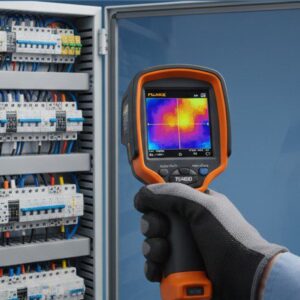
At Smart Power Solutions, every Thermal Infrared Electrical Audit is completed using the Fluke Ti480 PRO Infrared Camera—Fluke’s elite flagship imager engineered specifically for industrial reliability work. This professional-grade instrument provides unmatched clarity, precision, and diagnostic depth.
Thermal inspection techniques used in this audit include:
- infrared thermographic survey;
- electrical thermography inspection;
- thermal imaging electrical panel inspection;
- infrared electrical scanning for hotspot detection;
- thermal electrical inspection under live load conditions.
This combination of advanced tools and engineering methodology helps detect failures caused by resistance, overload, harmonics, corrosion, or mechanical wear—often months before they result in shutdowns. The results of this audit seamlessly complement our services in Power Quality Diagnostics and Power Quality Solutions, forming an integrated reliability program.
II. Why Canadian Facilities Rely on Infrared Electrical Inspection
Electrical systems degrade slowly and predictably. More than 80% of failures produce measurable thermal symptoms before the breakdown occurs. Infrared predictive maintenance translates these early thermal indicators into clear, manageable tasks for the maintenance team.
Thermal Infrared Electrical Audit makes it possible to identify:
- overheated breakers and disconnects;
- oxidized or loose terminations;
- unbalanced three-phase loads;
- damaged insulation and heat-stressed components;
- overloaded buses and feeders;
- harmonic neutral overheating;
- bearing degradation in motors;
- faults in MCCs and VFDs;
- corrosion-induced high resistance;
- phase imbalance due to distribution issues.
These findings are categorized using ΔT measurements and evaluated according to the NETA Maintenance Testing Standard (MTS). Where required, the results can be integrated into your overall maintenance program in accordance with CSA Z463.
III. The Essential Role of the Fluke Ti480 PRO
The accuracy of a Thermal Infrared Electrical Audit depends heavily on the imaging instrument. Many low-cost cameras miss small anomalies or produce unreliable measurements. That is why Smart Power Solutions exclusively uses the Fluke Ti480 PRO — a high-performance, industrial-class infrared imager trusted by electrical engineers, utilities, and reliability professionals worldwide. You can find more information about the instrument family on the manufacturer’s website Fluke.
Below is a detailed breakdown of its most important capabilities:
| Fluke Ti480 PRO Feature | Key Technical Advantage |
|---|---|
| 640 × 480 Infrared Resolution | Captures precise thermal signatures, allowing analysis of tiny components and subtle defects. |
| MultiSharp™ Focus | Every object in the field of view is automatically sharp and clear—critical for switchgear. |
| LaserSharp™ Auto Focus | Laser-measured distance ensures perfect focus on every inspected connection. |
| IR-Fusion™ Technology | Thermal + visual overlay simplifies identification during reporting and repairs. |
| Thermal Sensitivity < 0.05°C | Detects tiny temperature differences invisible to standard imagers. |
| Temperature Range up to +1000°C | Essential for heavy industrial systems, busbars, transformers, and high-energy panels. |
| High Frame Rate Imaging | Smooth scanning of large equipment areas without motion blur. |
| Field-Replaceable Lenses | Wide-angle and telephoto lenses adapt to any equipment distance or size. |
| Radiometric Video Capture | Records temperature data in every frame—ideal for intermittent electrical issues. |
| 24-bit Color Display | Improves interpretation of subtle thermal gradients. |
| Rugged Industrial Build | Dust, shock, and vibration resistance for harsh industrial environments. |
| On-board Annotation | Voice and text notes simplify communication with maintenance teams and insurers. |
These capabilities elevate the Thermal Infrared Electrical Audit to a world-class engineering diagnostic tool rather than a simple contractor-level inspection.
IV. Complete Process of Thermal Infrared Electrical Audit
1. Pre-Inspection Engineering Review
We study electrical drawings, SLDs, breaker schedules, and operational constraints. This ensures full audit coverage across all mission-critical assets.
2. Live Infrared Electrical Inspection
Using the Fluke Ti480 PRO, all electrical components are scanned under normal load conditions. No shutdown is required. The inspection also complements our other reliability services, including Ultrasound Imaging for Energy Loss and Grounding & Lightning Protection.
3. Interpretation Through ΔT Analysis
Temperature differentials are compared with NETA MTS tables and evaluated in the context of load, environment, and equipment type.
4. Root Cause Engineering
Findings are analyzed to determine whether heat is caused by resistance, overload, harmonics, imbalance, corrosion, mechanical wear, or environmental factors. In more complex cases, our recommendations may include additional power quality analysis or in-depth Power Quality Diagnostics.
5. Documentation and Reporting
Each anomaly is documented with both thermal and visual images, severity rating, ΔT value, and corrective recommendations. This reporting format is convenient both for operating personnel and for auditors and insurance companies.
V. Equipment Inspected
Commonly inspected components include:
- main switchgear and distribution panels;
- three-phase motors and starters;
- transformers and dry-type units;
- MCC buckets and VFD panels;
- UPS systems, ATS units, and server racks;
- industrial ovens, heaters, HVAC systems;
- renewable energy inverters and combiner boxes.
These assets require the accuracy and range of the Fluke Ti480 PRO to detect early failure patterns. Combined with our Power Quality Solutions, this creates a complete reliability strategy for your entire electrical distribution system.
VI. Final Deliverables
- Executive summary of all findings;
- Thermal + visual image sets (IR-Fusion);
- ΔT values and NETA-based severity ratings;
- Root cause explanation for each hotspot;
- Recommended corrective actions;
- Priority-based repair plan.
VII. Conclusion
A Thermal Infrared Electrical Audit is one of the most powerful tools available to modern facilities looking to minimize risk, reduce operational costs, and maintain continuous uptime. With electrical systems becoming increasingly complex—incorporating nonlinear loads, automation equipment, variable-speed drives, and high-efficiency power electronics—the ability to detect early-stage thermal anomalies is no longer optional. It is essential.
By relying on the industry-leading Fluke Ti480 PRO and applying a structured engineering methodology based on NFPA 70E, NETA MTS, CSA Z463 and research published through IEEE, Smart Power Solutions delivers thermal inspections at a level unmatched by conventional contractors. This audit empowers your maintenance team with precise, actionable intelligence that prevents failures, protects personnel, eliminates unplanned downtime, and extends the lifespan of critical electrical assets.
Our Thermal Infrared Electrical Audit service naturally complements power quality diagnostics, ultrasound imaging for energy loss, and comprehensive grounding and lightning protection solutions. Together, they form a holistic, predictable, and well-documented reliability strategy for your facility.
Schedule your Thermal Infrared Electrical Audit today and secure measurable reliability, safety, and operational continuity for your facility.
VIII. Frequently Asked Questions (FAQ)
1. What is the purpose of a Thermal Infrared Electrical Audit?
An infrared thermographic electrical assessment is designed to detect electrical faults at their earliest stage by identifying abnormal temperature patterns inside energized equipment. This method supports infrared electrical inspection, infrared predictive maintenance, and electrical thermography inspection practices. It prevents costly failures by revealing hidden hotspots, loose terminations, overloaded circuits, and insulation degradation. Many facilities integrate this audit into a comprehensive industrial electrical safety inspection program to reduce risks and improve uptime.
2. How does infrared thermographic survey technology work?
An infrared thermographic survey detects the infrared radiation naturally emitted by electrical components under load. High-resistance connections, electrical load imbalance, faulty equipment, and deteriorated insulation all produce distinctive thermal signatures. Using advanced instruments like the Fluke Ti480 PRO, these abnormalities become clearly visible long before mechanical or visual symptoms appear. This technology is widely used for electrical panel thermal scan applications, thermal scan for electrical systems, and infrared electrical scanning.
3. Can a Thermal Infrared Electrical Audit prevent arc flash incidents?
Yes. A significant percentage of arc flash events are caused by loose, corroded, or improperly torqued electrical connections—conditions that generate heat long before they fail. Through infrared inspection for arc flash prevention, early-stage thermal anomalies are identified and addressed before they escalate. This reduces the probability of Arc Flash Category events and aligns with NFPA 70E requirements.
4. Is infrared electrical inspection suitable for all types of facilities?
Absolutely. This type of inspection is used in manufacturing plants, hyperscale data centers, hospitals, mining operations, commercial office towers, food production facilities, warehouses, renewable energy farms, and high-voltage substations. It is particularly valuable for operations where downtime is extremely expensive or safety is critical. For example, a preventive maintenance infrared audit is mandatory for many government, aviation, and healthcare facilities.
5. What equipment benefits the most from infrared electrical scanning?
Components that typically benefit include:
- switchgear and electrical panels;
- transformers and bus ducts;
- motor control centers (MCCs);
- variable frequency drives (VFD panels);
- automatic transfer switches (ATS units);
- UPS systems and battery banks;
- three-phase motors and starters;
- distribution feeders and branch circuits;
- renewable energy inverters and solar combiner boxes.
These components often suffer from electrical load imbalance detection issues, phase-related stress, and harmonic-induced heating—faults that can only be reliably identified through thermal imaging electrical panel inspection or industrial infrared inspection.
IX. Common Electrical Failure Scenarios Identified Through Infrared Inspection
1. Electrical Hotspot Detection
Electrical hotspots are among the most common anomalies discovered during an infrared electrical scanning procedure. These hotspots often indicate dangerous resistance buildup caused by loose lugs, improper torque during installation, corrosion, conductive dust contamination, or insulation deterioration. If left unresolved, these issues may escalate to arcing faults or thermal runaway.
2. Electrical Panel Thermal Scan Findings
During an electrical panel thermal scan, technicians frequently identify overheating breakers, neutral bus issues, overloaded circuits, and phase imbalance. Many panels operate near or above their intended load capacity, especially in older buildings or facilities that have expanded production without upgrading their electrical infrastructure.
3. Thermal Audit for Switchgear
Switchgear issues are among the most dangerous due to high energy levels. A thermal audit for switchgear typically identifies deteriorated contacts, loose bolted joints, oxidized busbar interfaces, and mechanical wear in disconnect mechanisms. These defects may remain invisible until a severe incident occurs, making thermal scanning an essential diagnostic tool for medium-voltage and high-voltage systems.
4. Infrared Electrical Fault Detection
Infrared electrical fault detection allows technicians to identify wiring faults, unbalanced loads, deteriorating transformer windings, poor neutral bonding, and hidden mechanical friction in motors. These faults exhibit unique thermal profiles depending on their severity, ambient temperature, and load conditions.
5. Electrical Load Imbalance Detection
Load imbalance is a common problem in facilities with numerous three-phase motors, single-phase lighting loads, and non-linear power electronics. Load imbalance increases operating temperatures on one or more phases, reduces motor lifespan, raises energy consumption, and can even trigger nuisance tripping. Infrared inspection quickly visualizes load asymmetry, making corrective action easier.
X. Industry Applications and Use Cases
1. Manufacturing and Industrial Automation
Modern automated production lines rely heavily on MCCs, VFDs, PLC control panels, servo motor systems, and robotic equipment. Thermal electrical inspection identifies stress on power distribution components and helps prevent production stoppages. Integrating infrared predictive maintenance ensures minimal downtime and extends the lifespan of mission-critical equipment.
2. Commercial Buildings and High-Rise Complexes
In commercial buildings, electrical infrastructure often evolves over time as tenants change and electrical loads shift. Thermal imaging electrical panel inspection helps property managers maintain safe and efficient distribution panels, HVAC equipment, elevator systems, emergency power generators, and data closets. It is also required by many insurers for liability reduction.
3. Hospitals and Healthcare Facilities
Healthcare facilities rely on redundant power systems, UPS banks, medical imaging equipment, and HVAC systems. An industrial infrared electrical reliability scan is used to ensure continuous power availability and to comply with electrical safety and accreditation requirements. Preventing unplanned shutdowns is crucial for patient safety and life-support equipment reliability.
4. Data Centers and IT Infrastructure
Data centers operate at extremely high energy densities. Even minor electrical defects can lead to catastrophic failures. Infrared thermography inspection is used for rack PDUs, UPS modules, battery banks, cooling systems, and switchgear. Infrared electrical inspection reduces the risk of thermal hotspots that could trigger system-wide outages.
5. Food Processing and Refrigeration Facilities
Electrical failures in refrigeration systems can destroy inventory worth millions. Thermal imaging protects compressors, evaporator fans, PLC panels, and distribution circuits. Predictive maintenance infrared audit practices are essential in these environments to ensure reliability and compliance with food safety regulations.
6. Mining, Heavy Industry, and Energy Sector
Mining operations, foundries, and energy-generation sites require rugged electrical systems that withstand extreme loads. Industrial infrared thermography inspection identifies early mechanical wear, conductor fatigue, and electrical degradation in harsh environments where traditional inspections may be unsafe or impractical.
XI. Extended Technical Guide: What Causes Thermal Anomalies?
Thermal anomalies may be caused by a variety of electrical, environmental, and mechanical factors. The following list describes some of the most frequent technical root causes found during industrial infrared inspection:
- Ohmic heating: caused by high resistance, loose terminations, or corrosion.
- Magnetic heating: due to overloaded transformers or induction fields.
- Harmonic heating: caused by nonlinear loads such as VFDs and LED drivers.
- Eddy current losses: often found in transformers, motors, and busbar systems.
- Environmental heat accumulation: poor ventilation, dust buildup, or enclosure overheating.
- Mechanical friction: failing motor bearings or misaligned rotating equipment.
- Undersized conductors: improper installation or load growth over time.
- Unbalanced loads: phase asymmetry leading to overheating on one phase.
- Neutral conductor overload: typically caused by high triplen harmonics.
- Insulation degradation: age, moisture, or thermal cycling leading to breakdown.
Analyzing these patterns requires specialized expertise. This is why our audits go far beyond basic thermal imaging—they combine industrial electrical thermography, infrared electrical inspection, and root-cause engineering.
XII. Compliance, Reporting, and Documentation
1. Standards Supported
Our Infrared Thermographic Electrical Assessment aligns with major electrical and maintenance standards including:
- NFPA 70E – Electrical Safety in the Workplace
- NETA MTS – Maintenance Testing Standard
- CSA Z463 – Maintenance of Electrical Systems
- IEEE maintenance and safety publications
- ISO thermal imaging best practices
2. Insurance Compliance
Many insurance companies now require regular infrared electrical inspection for commercial and industrial facilities. Our reports meet insurer documentation standards and significantly reduce fire-related risk exposure.
3. Deliverables
Deliverables include radiometric thermal images, IR-Fusion visuals, ΔT values, priority ranking, root-cause analysis, and clear corrective recommendations. Our documentation supports audits, inspections, risk assessments, and compliance reporting.
XIII. Integration Into a Complete Maintenance Strategy
A high-resolution electrical thermography audit is not an isolated procedure. When combined with power quality diagnostics, ultrasound leak detection, grounding system evaluation, and periodic mechanical inspections, it becomes part of a comprehensive predictive maintenance ecosystem.
This ecosystem enhances:
- electrical reliability,
- equipment lifespan,
- energy efficiency,
- safety compliance,
- maintenance planning accuracy,
- overall operational uptime.
As facilities transition to modern Industry 4.0 models, infrared predictive maintenance becomes increasingly essential—not only for diagnosing faults but also for building long-term reliability strategies.
XIV. Final Notes
By expanding your maintenance program with infrared thermography inspection, thermal imaging electrical panel inspection, infrared electrical scanning, and industrial infrared inspection practices, you dramatically reduce the risk of electrical failure. These methods reveal hidden defects long before they become dangerous or expensive to repair.
When combined with advanced tools like the Fluke Ti480 PRO and performed by certified thermographers, a professional infrared electrical reliability inspection becomes one of the most valuable and cost-effective reliability tools available to modern facilities.
Schedule your infrared predictive electrical maintenance audit today and secure measurable reliability, safety, and operational continuity for your facility.
Contact Us
To get a quote
To get a solution
To ask a technical question