
Detuned Capacitor Bank Design for Harmonic-Rich Electrical Networks
In modern harmonic-rich electrical networks, engineered detuned capacitor systems are essential to prevent resonance, overheating, and long-term equipment damage. In Ontario industrial facilities dominated by variable frequency drives (VFDs), rectifiers, switched-mode power supplies, and automated production systems, harmonic distortion is not a secondary concern—it is a defining engineering constraint.
Traditional capacitor banks were designed for linear systems. Today’s industrial electrical environment is fundamentally different. Without proper impedance modeling and harmonic evaluation, installing a standard capacitor bank may amplify distortion rather than reduce electrical stress. This is why engineered detuned capacitor bank design is often required as part of safe Power Factor Correction.
Why Detuned Compensation Is Critical in Harmonic-Rich Electrical Networks
A harmonic-rich electrical network contains nonlinear loads that inject current distortion at multiples of the fundamental frequency. In North America, dominant harmonic orders are typically the 5th (300 Hz) and 7th (420 Hz), though higher orders are common in dense automation environments.
When capacitance is added to such systems without analysis, parallel resonance can occur between transformer inductance and capacitor reactance. This condition may result in:
• Amplified harmonic current
• Increased RMS loading
• Rapid capacitor overheating
• Transformer insulation stress
• Breaker nuisance tripping
• Unexpected equipment shutdown
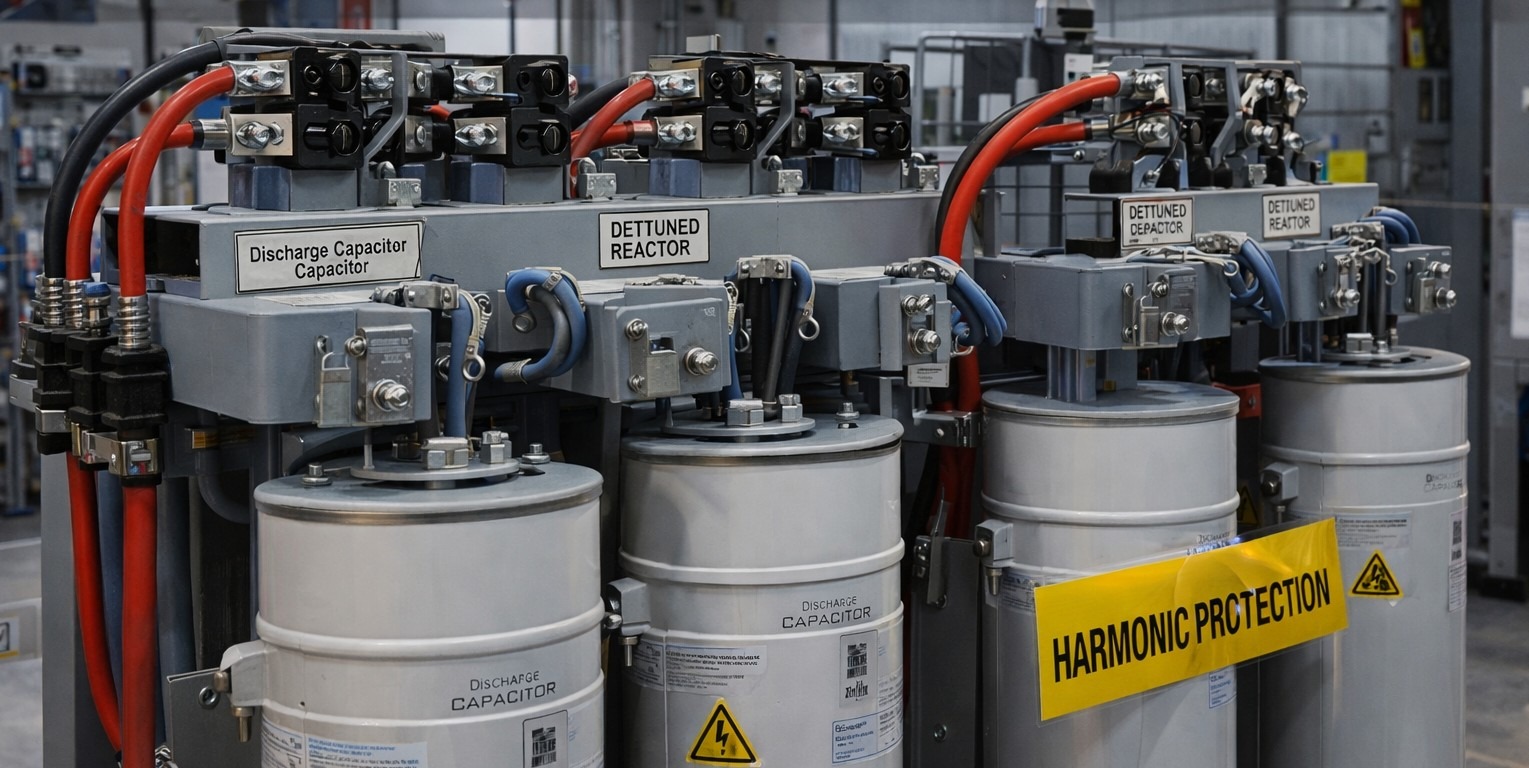
Properly engineered detuned compensation systems prevent resonance by intentionally shifting the system’s resonant frequency below dominant harmonic components.
Understanding Capacitor Bank Resonance Protection
Capacitor bank resonance protection is achieved by introducing series reactors with each capacitor stage. These reactors increase system inductance in a controlled manner, effectively lowering the resonant frequency.
The most common approach involves 5.67% detuning, but this value is not universal. In some facilities, a different percentage is required depending on harmonic spectrum characteristics and short-circuit strength.
This is where 5.67% detuned reactor design becomes an engineered decision—not a catalog selection.
Measurement-Driven Harmonic Mitigation Capacitor Bank Engineering
Every harmonic mitigation capacitor bank project should begin with site-specific measurement. At Smart Power Solutions, we integrate harmonic evaluation with Power Quality Diagnostics to capture:
• Total Harmonic Distortion (THD)
• Individual harmonic magnitude
• Harmonic current under peak load
• Transformer impedance and X/R ratio
• Short-circuit ratio at the point of common coupling
This dataset allows us to engineer an industrial harmonic filtering solution that supports stable reactive compensation without introducing amplification risk.
Power Factor Correction with Harmonics: Engineering Challenges
Power factor correction with harmonics requires balancing two objectives: reducing displacement PF while preventing harmonic amplification. Conventional capacitor banks address reactive power but may worsen distortion in nonlinear environments.
Detuned systems ensure that reactive compensation occurs without attracting excessive harmonic current. This stabilizes waveform behavior and protects electrical assets.
In facilities across Ontario, detuned capacitor bank Ontario projects have become increasingly common as automation density rises.
IEEE 519 Harmonic Compliance and Ontario Engineering Practice
While not legally mandated in all cases, IEEE 519 harmonic compliance is widely recognized as best engineering practice. The standard provides guidance on acceptable current and voltage distortion levels.
Reference materials:
IEEE 519 Standard Overview
IEC 61000-4-30 Publication
Our detuned capacitor bank design methodology aligns with IEEE 519 harmonic compliance principles while tailoring implementation to Ontario industrial environments.
Thermal and Equipment Stress Considerations
Harmonic currents increase RMS current, leading to elevated temperature rise in transformers, busbars, and cables. Without mitigation, insulation aging accelerates and equipment life shortens.
Where overheating risk is identified, findings are validated through Thermal Infrared Electrical Audit. This ensures that detuned compensation improves reliability rather than exposing hidden weaknesses.
Grounding Stability and Harmonic Interaction
Triplen harmonics may accumulate in neutral conductors in four-wire systems. Improper bonding can create voltage reference instability in control circuits. Where necessary, we coordinate detuned bank design with a Grounding System Audit to confirm safe system reference behavior.
Commissioning and Verification
Post-installation measurement confirms that:
• Resonance is avoided
• THD does not increase
• Capacitor temperature remains stable
• PF remains within target band
• Reactor current stays within rating
This verification step ensures the engineered capacitor bank solution performs as intended under real operating conditions.
Operational and Financial Benefits
When properly engineered, detuned compensation provides:
• Stable power factor correction with harmonics present
• Reduced electrical stress
• Lower maintenance frequency
• Improved transformer utilization
• Extended capacitor lifespan
• Reduced risk of costly downtime
In harmonic-rich electrical networks, engineered detuned compensation is not optional—it is structured electrical risk mitigation.
Contact Smart Power Solutions to schedule a harmonic evaluation and design a detuned compensation system tailored to your facility.
Advanced Reactor Engineering: Beyond Standard 5.67% Detuning
While 5.67% detuned reactor design is common in many industrial environments, it is not universally correct. The detuning percentage must be selected based on harmonic spectrum distribution, short-circuit ratio, transformer impedance, and projected load evolution.
In harmonic-rich electrical networks with dominant 5th harmonic distortion, 5.67% detuning typically shifts resonance to approximately 189 Hz. However, in facilities where 7th harmonic magnitude is dominant or where the network is electrically weak, alternative detuning percentages may provide greater capacitor bank resonance protection.
This is why professional detuned capacitor bank design requires impedance modeling rather than reliance on default catalog solutions.
Short-Circuit Ratio and System Strength Analysis
The electrical strength of the network significantly influences resonance behavior. Facilities with high short-circuit capacity relative to load (strong systems) are less sensitive to resonance shifts than weak systems with lower short-circuit ratios.
In weak systems, even moderate capacitance addition can create substantial resonance amplification. Proper harmonic mitigation capacitor bank engineering includes:
• Short-circuit current calculation at the point of common coupling
• Transformer percent impedance validation
• Feeder impedance modeling
• Load-to-source ratio assessment
Without this analysis, capacitor bank resonance protection cannot be guaranteed.
Reactor Saturation and Nonlinear Behavior
Detuned reactors operate under continuous harmonic current stress. If improperly sized, magnetic core saturation may occur, especially under elevated harmonic RMS conditions. Saturation reduces effective inductance and shifts the tuned frequency, potentially moving the system closer to a dominant harmonic.
Therefore, engineered detuned systems must consider:
• Core material characteristics
• Continuous harmonic current capability
• Temperature rise under nonlinear loading
• Overcurrent protection margins
This ensures the reactor remains stable even under worst-case harmonic conditions.
Transformer K-Factor and Harmonic Heating
Harmonics increase eddy current losses in transformer windings. In severe cases, transformers may require K-factor rating adjustments. Even where replacement is unnecessary, harmonic mitigation improves transformer thermal behavior and reduces insulation aging.
By implementing an engineered capacitor bank solution with proper detuning, harmonic current magnitude seen by upstream transformers is stabilized. This supports long-term asset reliability.
Cable Heating and Neutral Current Impact
Harmonic currents increase effective RMS loading in feeders. Triplen harmonics accumulate in neutral conductors in four-wire systems, increasing heating and potentially exceeding conductor ratings.
Detuned compensation stabilizes current distribution by preventing harmonic amplification. In facilities where neutral stress is suspected, we may coordinate evaluation with a Grounding System Audit to ensure safe bonding and conductor integrity.
Arc-Flash Considerations and Fault Behavior
Reactive compensation changes fault current contribution characteristics. Although detuned reactors introduce additional impedance, they must be evaluated within overall protection coordination and arc-flash modeling studies.
Proper reactor-integrated capacitor solutions include review of:
• Protection device coordination
• Fault current contribution from capacitor stages
• Clearing time validation
• Equipment short-circuit rating compliance
This ensures the compensation system does not negatively impact safety margins.
Future Expansion and Scalability Planning
Industrial facilities evolve. Load density increases, automation expands, and additional nonlinear devices are added. An engineered detuned system should anticipate future harmonic growth rather than only current conditions.
Scalable industrial harmonic filtering solution planning includes:
• Modular stage architecture
• Space allowance for future reactor additions
• Conservative harmonic spectrum assumptions
• Margin in thermal and current ratings
This avoids redesign when facility demand grows.
Coordination with Dynamic Compensation Systems
In facilities requiring both fast reactive tracking and harmonic protection, detuned banks may be integrated into dynamic switching systems. For example, base compensation may be detuned, while trim stages use fast switching logic.
This hybrid approach allows power factor correction with harmonics present while maintaining responsiveness under variable load conditions.
Dynamic strategies are further detailed in our broader Power Factor Correction engineering methodology.
Ontario Industrial Case Scenario
An Ontario manufacturing facility operating 60+ VFD-driven motors experienced capacitor overheating after installing a conventional bank. THD levels increased from 6% to 11% post-installation.
Through structured harmonic evaluation, resonance was identified near the 5th harmonic. A revised detuned capacitor bank Ontario solution with engineered 5.67% reactor design reduced amplification, stabilized THD at 4–5%, and eliminated overheating.
This example demonstrates that resonance protection is not theoretical—it directly impacts asset longevity.
Integration with Thermal and Energy Audits
Harmonic mitigation improves thermal performance and reduces RMS stress. Where broader reliability assessment is required, detuned design may align with Thermal Infrared Electrical Audit findings.
Additionally, waveform stability supports accurate energy-loss identification through Ultrasound Imaging for Energy Loss, ensuring that energy optimization efforts are not distorted by unstable electrical conditions.
Commissioning Protocol for Detuned Systems
Commissioning is a controlled process including:
• Pre-energization insulation resistance testing
• Reactor impedance verification
• Controlled energization sequence
• Post-installation harmonic measurement
• Thermal scan under load
Only after confirming stable THD and temperature performance can the system be considered fully validated.
Lifecycle Cost Reduction
Although detuned systems may require higher initial investment than conventional capacitor banks, lifecycle cost is typically lower due to:
• Reduced maintenance frequency
• Extended capacitor lifespan
• Lower transformer stress
• Avoided production downtime
• Improved electrical stability
From a risk management perspective, engineered detuned compensation protects both operational continuity and capital investment.
Engineering Conclusion
In harmonic-rich electrical networks, conventional compensation can introduce unintended resonance and equipment stress. Structured, measurement-driven detuned compensation engineering ensures that reactive power correction occurs safely, efficiently, and in alignment with IEEE 519 harmonic compliance principles.
For Ontario industrial facilities seeking long-term reliability and measurable electrical stability, engineered detuned compensation represents the most responsible approach to modern Power Factor Correction.
Contact Smart Power Solutions to schedule a detailed harmonic assessment and implement a safe, engineered capacitor bank solution tailored to your facility.
Contact Us
To get a quote
To get a solution
To ask a technical question