
High-Speed Dynamic Power Factor Control for Variable Industrial Loads
Industrial electrical systems in Ontario have changed dramatically over the last decade. Most facilities now rely on equipment that introduces fast load variation: variable frequency drives (VFDs), automated production lines, robotics, packaging equipment, refrigeration compressors, controlled HVAC systems, conveyors, welders, and dense electronic power supplies. In these environments, power factor is not a steady value—it moves throughout the day as loads ramp up and down, start and stop, and shift between process states.
This is exactly where dynamic power factor control becomes essential. Instead of treating reactive compensation as a static add-on, dynamic control treats it as an active system that tracks reactive demand in real time and maintains stable power factor across changing operating conditions. When engineered correctly, it reduces kVA loading, stabilizes voltage behavior, and improves reliability in sensitive industrial networks.
At Smart Power Solutions, our approach is measurement-driven and designed to support the broader objective: measurable, reliable Power Factor Correction that holds up under real production conditions—not just in theory.
Below, we explain how high-speed dynamic control works, why static systems often fail in modern facilities, and how we engineer stable performance for Ontario industrial sites.
Why Power Factor Becomes Unstable in Modern Facilities
In many plants, reactive power demand changes faster than traditional capacitor banks can respond. A common scenario: a set of VFD-driven motors ramps from low speed to full speed, or multiple compressors cycle at the same time. kVAR can swing rapidly, while kW may appear relatively stable. If the correction system is slow or poorly staged, the facility’s power factor will drift below the target band during these transitions.
Unstable power factor is not just a billing issue. It can increase current in feeders and switchgear, raise losses, elevate temperature rise, and reduce available kVA capacity for future expansion. Over time, this may contribute to nuisance trips, overloaded equipment, and reduced asset life. That’s why dynamic power factor control is treated as a reliability discipline as much as an energy discipline.
High-Speed PF Control in Ontario: What It Actually Means
The phrase high-speed PF control Ontario is often used loosely. In engineering terms, “high-speed” means the control system can respond fast enough to follow the facility’s real reactive demand changes without hunting or overcompensating. Achieving this is not only about buying a controller—it is about designing the entire system: measurement inputs, step architecture, switching technology, control logic, protection, and commissioning verification.
For some facilities, a well-engineered conventional automatic bank with correct stage sizing and delay settings is sufficient. For highly dynamic loads, fast switching and advanced algorithms are required. The correct choice depends on what your facility actually does day-to-day.
Measurement-Based Engineering: Start with Real Data
Every dynamic control project should begin with multi-day measurement and correlation of kW, kVAR, kVA, voltage behavior, and process state. This is often integrated with our Power Quality Diagnostics work so we can see how electrical performance aligns with operations.
We look for patterns such as:
• How fast reactive demand changes (ΔkVAR over time)
• How often transitions happen (events per hour/day)
• Whether PF dips are tied to specific machines or process stages
• Whether PF becomes leading during light load periods
• Whether kVA peaks align with production peaks or transient behavior
These measurements are the foundation for stable dynamic power factor control, because they allow us to engineer response speed and stage structure around reality—rather than guessing.
Automatic Capacitor Bank Control: Why “Automatic” Is Not Enough
Many facilities already have automatic capacitor bank controllers, yet still experience unstable PF, switching chatter, and unexplained performance issues. The key reason is that “automatic” does not mean “properly engineered.” A controller can only perform as well as the system it controls.
Proper automatic capacitor bank control requires correct stage sizing, correct switching delays, and correct control bandwidth. If stage sizes are too large, the system overshoots and oscillates. If stages are too small, the bank may switch continuously and still fail to track the load. If delays are wrong, the controller hunts.
Engineering goals include:
• Stable PF within a realistic band (not aggressive setpoints that cause hunting)
• Minimal switching events for asset life
• Fast response where required, but not “twitchy” behavior
• Safe behavior under light load and partial shutdown
All of this is part of a professional dynamic power factor control design.
kVAR Step Control Tuning: The Hidden ROI Driver
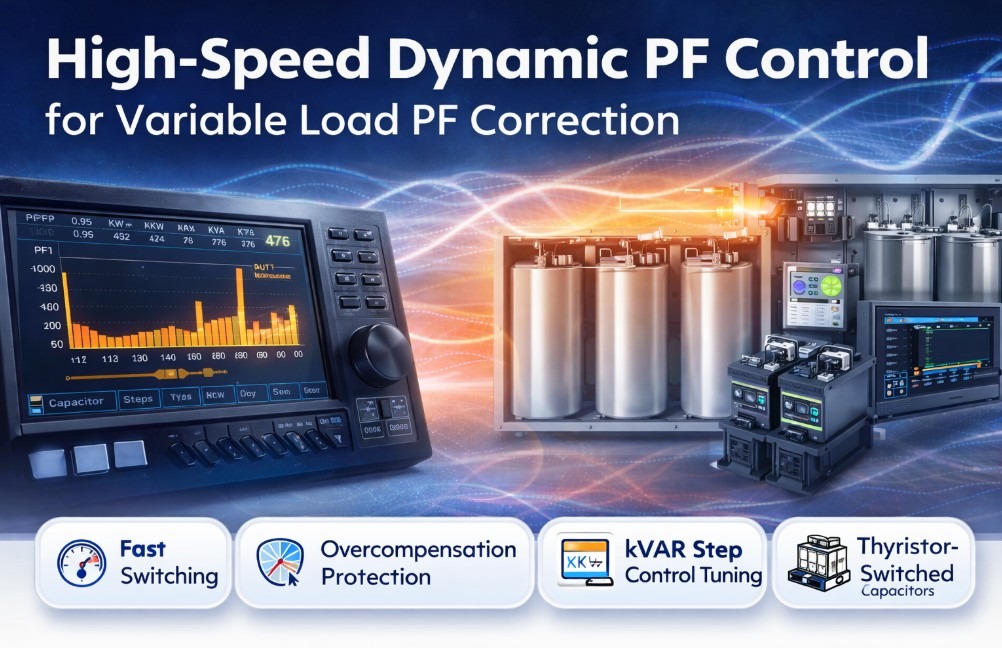
One of the most important success factors is kVAR step control tuning. This includes selecting the number of stages, the stage size distribution, and the sequencing logic. Many systems fail because they use equal stages that do not match the facility’s reactive swing behavior.
We commonly engineer step architecture using a combination of base and trim stages. For example, base stages cover the normal operating region, and trim stages stabilize during transitions. The controller is tuned with:
• Target PF band selection (with realistic deadband)
• Switching delay and anti-hunting logic
• Minimum on/off time to prevent chatter
• Priority rules to avoid unnecessary step cycling
When kVAR step control tuning is correct, PF becomes stable, switching count drops, and the system behaves predictably across operational modes.
Thyristor-Switched Capacitor System: When Fast Switching Is Required
In facilities with extremely frequent load changes, mechanical contactors may not be the best switching method. A thyristor switched capacitor system (TSC) uses solid-state switching to connect capacitor stages quickly and repeatedly without mechanical wear. This can be critical in environments with rapid process cycling, frequent motor starts, or short production sequences.
The objective is rapid PF compensation industrial environments require—fast enough to stabilize PF during transitions, and stable enough to avoid introducing new power-quality problems. However, TSC systems must be designed carefully to ensure compatibility with the facility’s harmonic environment and protection coordination.
Where harmonics are present, dynamic switching strategy may need to be coordinated with detuned designs or harmonic mitigation principles. This is aligned with the engineering approach described on the broader Power Factor Correction service page.
Power Factor Correction for VFD Loads: What Changes
Power factor correction for VFD loads requires different thinking than correction for traditional motor loads. VFDs can present both displacement and distortion power factor components. While capacitor banks address displacement PF, the presence of harmonics and rectifier behavior can change how a bank should be placed and tuned.
In VFD-heavy facilities, we evaluate whether correction should be centralized at the main switchboard or distributed closer to major loads. Centralized correction is simpler to maintain, but distributed correction can reduce feeder current and improve localized voltage stability. The correct choice depends on the electrical topology, cable lengths, load grouping, and operational constraints.
This is a key part of power quality engineering Ontario facilities need when modern automation and electronic loads dominate the network.
Prevent Overcompensation Power Factor: Light-Load Stability
A major operational issue is leading PF during light load. If capacitors remain connected as kW falls (night shifts, weekends, seasonal downtime, partial production), the network can become overcompensated. That can increase voltage, stress equipment insulation, and contribute to unpredictable behavior in sensitive systems.
Engineering controls to prevent overcompensation power factor include:
• Conservative cut-out thresholds under low kW
• Minimum step logic (avoid leaving base steps on when load drops)
• Time-based stability checks (avoid toggling due to momentary events)
• Controller setpoints aligned with real operations
When engineered properly, dynamic power factor control remains stable both at peak production and at low load—without chasing the setpoint or causing switching chatter.
Voltage Stability, Reliability, and Equipment Stress
Power factor is directly linked to current magnitude. Low PF increases current for the same real power delivery, which increases I²R losses, temperature rise, and voltage drop in long cable runs and bus ducts. Correcting PF reduces current, which can improve voltage stability and reduce thermal stress in switchgear, feeders, and transformer components.
Where thermal risk is suspected, dynamic PF projects may be coordinated with our Thermal Infrared Electrical Audit to identify hot spots, loose connections, or equipment operating near thermal limits. This helps ensure the PF solution improves reliability rather than revealing hidden weaknesses after the fact.
In facilities with reference stability concerns or neutral/ground noise issues, we may align the PF project with a Grounding System Audit to confirm safe bonding and predictable reference behavior. This is especially relevant in plants with sensitive instrumentation, PLC networks, and communication cabling.
Commissioning That Matches Real Operations
Commissioning is where many projects succeed or fail. A dynamic control system must be verified under real operating conditions—during the same production cycles that created instability. We validate:
• PF behavior during peak demand and rapid transitions
• Switching count and stage stability
• Light-load leading PF behavior
• Voltage response and any unintended fluctuations
• Compatibility with control systems and process equipment
This verification step creates measurable proof that the Power Factor Correction Ontario strategy is not only installed, but also tuned and stable.
Case Example: Variable Process Line with Frequent Cycling
A common scenario is a plant where packaging lines cycle rapidly and multiple drives start/stop throughout the shift. The facility may have an automatic bank installed, yet still see PF instability and frequent stage switching. The root cause is often stage sizing that does not match the kVAR swing, combined with control delays that cause hunting.
In these cases, we redesign step architecture, apply kVAR step control tuning, and adjust controller logic to stabilize PF without excessive switching. If the process requires very fast response, we evaluate whether a thyristor switched capacitor system or hybrid approach is appropriate. The goal is stable performance and reduced wear—not just faster switching for its own sake.
How Dynamic Control Supports Capacity and Expansion
One of the less discussed benefits of effective dynamic power factor control is reclaimed kVA capacity. When PF is stable and reactive demand is controlled, transformers and feeders carry more useful work for the same thermal loading. This can allow facilities to add new machinery or expand operations without immediately upgrading incoming service capacity.
From a business perspective, that can translate into delayed capital upgrades and improved planning flexibility. From an engineering perspective, it reduces electrical stress and improves system stability under variable load conditions.
External Engineering References (Outbound Links)
Dynamic PF projects should be aligned with recognized engineering guidance and measurement practices. For reference resources commonly used in power quality and harmonic engineering, see:
IEEE 519 Standard Overview
IEC 61000-4-30 Publication
How This Fits Into the Full Smart Power Solutions Method
Dynamic control is one module within a broader optimization strategy. Many facilities combine PF projects with diagnostics and reliability services to maximize measurable outcomes. Depending on the site, a PF project may link directly with:
• Power Quality Diagnostics to capture load variability and events
• Thermal Infrared Electrical Audit to validate stress points under load
• Grounding System Audit where reference stability is critical
• Ultrasound Imaging for Energy Loss to quantify energy waste and reliability risks
All of this reinforces the primary objective: stable and measurable Power Factor Correction that supports uptime, safety, and long-term asset performance.
Next Step: Engineering Assessment and Design
If your facility experiences PF swings, frequent switching, leading PF at light load, or variable reactive demand caused by VFD-driven equipment, dynamic control may be the most practical solution. The right system depends on measured behavior and engineering design—not generic assumptions.
Contact Smart Power Solutions to schedule an assessment and develop a tailored dynamic control strategy that matches your operating profile and reliability requirements.
Contact Us
To get a quote
To get a solution
To ask a technical question