
Flickering and Voltage Fluctuation Ontario: Industrial Testing to Stop Process Issues
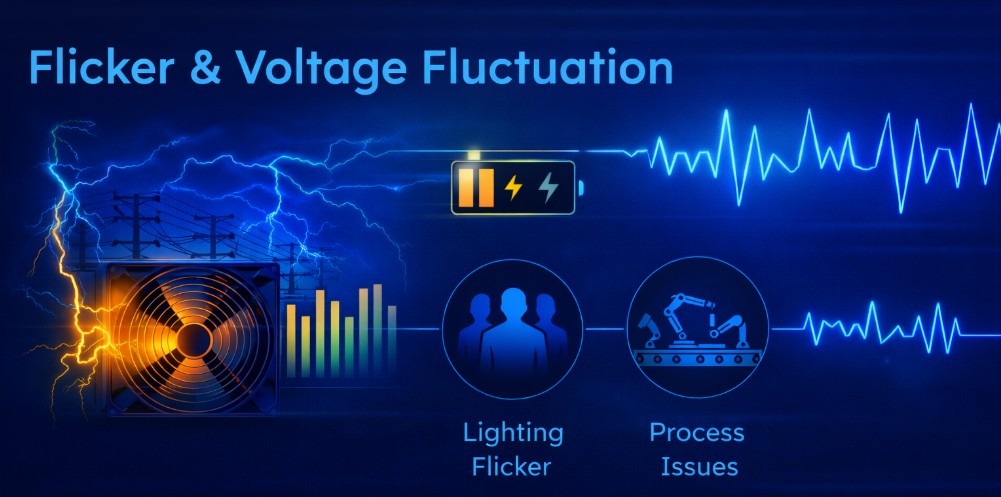
Flickering and Voltage Fluctuation Ontario is one of the most frustrating power quality problems in industrial facilities because it feels “soft” and unpredictable: lights shimmer, control panels behave inconsistently, welders or compressors seem to “pull the site down,” and operators start reporting process instability. But flicker is not a mystery. It is a measurable voltage variation pattern that can be captured, quantified, and traced to a real source—inside the plant, at the service, or upstream on the utility network.
This page explains how flicker is measured, what causes voltage fluctuations in real facilities, why it impacts processes (not only lighting), and how an investigation should be structured so the result is a practical mitigation plan—not just raw data. If you need a full system-level approach, start with Power Quality Diagnostics & Testing. To book a site assessment, use our contact anchor: https://smartpowersolutions.ca/#contact-form.

What Flicker and Voltage Fluctuation Really Mean
Flicker is the visible result of repetitive or irregular voltage variations. A facility can have “acceptable average voltage” and still experience flicker, because the human eye and many electronic systems react to changes—not just steady-state RMS values. In industrial environments, this often appears as:
- Lighting shimmer or pulsing in production areas
- HMI screens briefly dimming or resetting
- Sensitive instruments showing unstable readings
- Process issues that correlate with heavy cyclic loads
When clients ask for industrial flicker analysis Ontario, they usually want answers to two questions:
- Is this internal or utility-side?
- What mitigation will actually stop it?
To answer those properly, the investigation must include correct measurement methods, correct monitoring duration, and correlation with plant operations.
Why Flicker Is Not “Only a Lighting Problem”
Many people assume flicker is a comfort complaint. In industrial reality, the same voltage variation patterns that cause flicker can also cause process issues:
- Control power supplies operating near ride-through limits
- Contactors and relays dropping out during deeper fluctuations
- PLC I/O instability or nuisance faults
- VFD behavior changes when line voltage moves rapidly
This is why we treat voltage instability investigation Ontario as an operational reliability issue, not a cosmetic one. If you also suspect hidden heating, loose terminations, or overloaded components, combine the study with a thermal survey: Thermal Infrared Electrical Audit.
How Flicker Is Measured (Pst / Plt) and Why It Matters
Industrial flicker measurement is not “watching lights and guessing.” It is quantified using standardized methods that calculate flicker severity over time. The key outputs are:
- Pst – short-term flicker severity (typically 10 minutes)
- Plt – long-term flicker severity (typically 2 hours, derived from Pst values)
These values are used for flicker severity measurement Pst Plt and are the foundation of IEEE 1453 flicker compliance testing in North America. A professional report should show:
- Time-stamped Pst and Plt trends
- Correlation with facility events (starts, weld cycles, switching)
- Voltage fluctuation amplitude and repetition patterns
- Clear conclusion on origin and practical mitigation
For standard reference, IEEE’s flicker measurement guidance is commonly aligned with IEEE 1453. External reference: IEEE 1453 Standard (Flicker Measurement Guidance).
Most Common Industrial Causes of Flicker and Voltage Fluctuation
In lighting flicker industrial facility cases, the actual driver is usually one of these categories. The point is not to memorize the list—it’s to measure which one matches your facility’s signature.
1) Cyclic loads (welders, presses, furnaces)
Cyclic loads cause repetitive current changes that translate into voltage modulation. If the site electrical impedance is high, even moderate current swings create visible flicker. This is one of the most common triggers identified by industrial load fluctuation monitoring.
2) Large motor starts, compressors, and pump cycling
Repeated starts can create frequent voltage dips and rebounds. Even when the dip is not deep enough to be called a sag event, the repetition can create flicker and process nuisance faults.
3) Weak distribution sections (long feeders, undersized conductors, high impedance)
Voltage fluctuation severity increases downstream when feeder impedance is high. A facility may have stable voltage at the service entrance but unstable voltage deep in the plant. This is why two-point monitoring (service + affected area) is critical.
4) Power factor correction interaction and resonance
Capacitor banks can interact with harmonics and system impedance. Switching events or resonance conditions can amplify voltage variation and produce flicker-like symptoms. If your site has capacitor banks, this belongs in the scope: Power Factor Correction.
5) Utility-side fluctuations or shared infrastructure effects
Some flicker originates upstream and affects multiple customers. Good monitoring proves whether the disturbance appears at the service entrance and aligns with utility events.
Voltage Fluctuation Testing Industrial – What “Good” Looks Like
Proper voltage fluctuation testing industrial is not just “install a logger.” It’s an engineered plan designed to answer: what is the pattern, how severe is it, where does it originate, and what mitigation will remove the operational impact.
Step A – Define the operational symptom
We document what operators see and when it happens: which line, which process stage, what equipment is running, and whether complaints align with certain shifts or production schedules.
Step B – Choose monitoring points
At minimum, monitoring should include:
- Service entrance / main distribution reference point
- Panel feeding the affected area (or the most sensitive equipment)
This is the backbone of electrical disturbance root cause analysis and prevents blame-based troubleshooting.
Step C – Capture Pst/Plt and correlate to operations
We measure flicker indices while also tracking load behavior. This is why industrial load fluctuation monitoring is essential—flicker without current correlation is incomplete.
Step D – Convert data into decisions
A useful report does not end with graphs. It ends with ranked mitigation options, cost/complexity notes, and a verification plan.
If you need the full facility approach (harmonics, transients, sags, flicker), start at: power quality diagnostics Ontario.
How Flicker Creates Process Issues (Practical Examples)
Flicker complaints often arrive with other reliability symptoms. Here’s how voltage variation patterns connect to real operational issues:
- Control power sensitivity: Some PLC and network power supplies tolerate only limited voltage modulation before they behave unpredictably.
- Drive behavior: Certain VFDs adjust internal control behavior when line voltage moves rapidly, especially under heavy load.
- Relay/contactor drop-out margin: Even small fluctuations can cross drop-out thresholds if coils are already operating near limits.
- Instrumentation noise: Voltage instability can translate into unstable analog readings or nuisance alarms.
That is why voltage instability investigation Ontario should always include “what the process experienced” alongside the electrical record.
Mitigation Options That Actually Work
Mitigation must match the measured signature. If you haven’t measured Pst/Plt and correlated the load, you are guessing. Below are proven categories of solutions used after industrial flicker analysis Ontario confirms the root cause:
1) Reduce the fluctuation source (load-side)
- Stagger starts and prevent simultaneous motor starting
- Adjust welding schedules or control sequences
- Upgrade soft starters or tune VFD ramps where appropriate
2) Strengthen the electrical path (distribution-side)
- Improve feeder sizing or shorten long runs
- Correct poor terminations and high resistance joints
- Rebalance loads across phases where possible
3) Provide dynamic voltage support
- Dynamic reactive power support for fluctuating loads
- Static VAR solutions where justified
- Targeted solutions for the most sensitive area (not the whole plant)
4) Correct capacitor bank interactions
Where capacitor switching/resonance is involved, mitigation may include reactor tuning, staged switching logic, or revised correction strategy. If you suspect demand cost issues too, pair with: Energy Efficiency Audit.
What You Should Receive (Deliverables)
A professional Flickering and Voltage Fluctuation Ontario deliverable should include:
- Executive summary (what is happening + where it starts)
- Pst/Plt flicker indices with time stamps
- Correlation evidence (load/current patterns vs flicker patterns)
- Severity interpretation and compliance framing (IEEE-based approach)
- Ranked mitigation options (effectiveness + complexity)
- Verification plan (how you confirm the fix)
This is what turns measurements into reduced downtime and fewer complaints.
FAQ (10 Questions)
1) What is the fastest way to confirm flicker severity?
Measure Pst/Plt using the correct flicker algorithm while monitoring at the service entrance and the affected area.
2) Can flicker happen even if voltage looks “normal” on a meter?
Yes. Many meters average too slowly and miss the modulation pattern that creates flicker.
3) Is flicker always the utility’s fault?
No. Many cases are internal, especially with cyclic loads or high impedance distribution sections.
4) Why do some areas flicker more than others?
Downstream impedance, feeder length, and local load behavior can amplify fluctuation patterns in one zone.
5) What does Pst mean in practice?
Pst is short-term flicker severity; it helps quantify how noticeable and disruptive flicker is over a short window.
6) What does Plt add beyond Pst?
Plt represents longer-term behavior and shows whether flicker is sustained or intermittent across operating cycles.
7) Can harmonics make flicker worse?
Yes, especially when capacitors and system impedance create resonance or instability conditions.
8) Do LED lights make flicker easier to notice?
Often yes—some LED drivers respond strongly to voltage variations, making flicker more visible.
9) What mitigation works best for welding-related flicker?
Load management and dynamic support strategies are often effective, but selection must follow measured correlation.
10) How do we start a structured investigation?
Begin with Power Quality Diagnostics & Testing and book a site review here: https://smartpowersolutions.ca/#contact-form.
Next Steps
If you are dealing with recurring flicker complaints or voltage instability that affects production, you don’t need guesses—you need measured evidence and a mitigation plan tied to real operating conditions. Start with power quality diagnostics Ontario, and contact us via: https://smartpowersolutions.ca/#contact-form.
Contact Us
To get a quote
To get a solution
To ask a technical question