
Grounding System Audit & Upgrades
Advanced Grounding System Evaluation & High-Reliability Upgrades
I. What Problems an Advanced Grounding System Audit Identifies
Grounding and bonding failures account for a significant percentage of electrical safety incidents in industrial and commercial facilities. Our Grounding System Audit identifies the issues that most commonly lead to dangerous conditions, operational instability, and unexpected downtime.
- High Ground Resistance: Excessive resistance in the grounding electrode system increases touch/step voltage during faults and compromises fault clearing times; a targeted Grounding System Audit quantifies this risk.
- Improper or Missing Bonding: Poor bonding between metallic systems creates hazardous differences in potential during normal operation and fault conditions, which our Grounding System Audit documents and prioritizes.
- Neutral-to-Ground Issues: Loose, corroded, or incorrectly installed neutral–ground connections cause voltage fluctuations, harmonic distortion, and equipment failures that a detailed Grounding System Audit quickly uncovers.
- Soil Resistance Variability: Seasonal moisture changes impact grounding performance; improper electrode placement worsens this effect and is clearly identified during the Grounding System Audit.
- Lightning Protection Deficiencies: Inadequate grounding of surge protection systems exposes sensitive equipment to transient overvoltage. A Grounding System Audit verifies whether lightning protection is truly bonded to the grounding grid.
- Corroded Ground Rods or Conductors: Oxidation or underground corrosion severely weakens the grounding path, often without visible symptoms, which is why periodic Grounding System Audits are essential.
- Ground Loops: Unwanted conductive loops cause noise, interference, and unstable control signals in automation systems and are systematically eliminated as part of the Grounding System Audit.
II. Methodology & Engineering Standards
Our approach follows international grounding and bonding standards to ensure accuracy and code compliance. Every test and measurement in the Grounding System Audit adheres to proven engineering methodology while avoiding operational interruption.
- CSA C22.1 (Canadian Electrical Code): Requirements for grounding electrode systems, bonding, and permissible resistance levels.
- IEEE 80: Grounding in AC substation environments, step and touch voltage calculations that form the analytical core of a professional Grounding System Audit.
- IEEE 142 (Green Book): Best practices for industrial and commercial grounding systems applied throughout the Grounding System Audit process.
- NFPA 70 / NEC: Safety-driven grounding and bonding guidelines for equipment protection.
- IEC 60364: International grounding and earthing system classifications used to benchmark Grounding System Audit results.
All grounding inspections and calculations follow guidance from IEEE grounding standards and Canadian best practices published by CSA Group, ensuring that each Grounding System Audit aligns with current international safety requirements.
III. Instrumentation Used During the Audit
To achieve Class A precision, Smart Power Solutions uses a professional suite of Fluke diagnostic instruments specifically designed for grounding, bonding, resistance, and power stability analysis. The right tools are critical for a defensible Grounding System Audit that you can present to insurers, regulators, and internal stakeholders.
| Instrument | Technical Function |
|---|---|
| Fluke 1625-2 Ground Tester | Performs 3- and 4-pole fall-of-potential testing, selective stakeless testing, and soil resistivity measurement during the Grounding System Audit. |
| Fluke 1664 FC Multifunction Tester | Validates line, loop, and ground impedance; continuity; insulation resistance; and RCD performance as part of the Grounding System Audit validation stage. |
| Fluke 1587 FC Insulation Multimeter | Identifies insulation breakdown contributing to stray voltage and grounding instability, providing additional context to the Grounding System Audit findings. |
| Fluke 289 True-RMS Logging Multimeter | High-resolution trending of voltage stability, harmonics, and neutral-to-ground anomalies that support long-term Grounding System Audit analysis. |
| Fluke 376 FC Clamp Meter with iFlex | Measures fault current paths, load distribution, leakage currents, and bonding conductor integrity to complete the electrical picture in the Grounding System Audit. |
All tests are performed with professional-grade instrumentation from Fluke, ensuring accurate and repeatable measurements for every Grounding System Audit we deliver.
IV. Grounding System Audit – Step-by-Step Process
1. Pre-Audit Engineering Review
We evaluate single-line diagrams, grounding electrode design, bonding paths, lightning protection interfaces, surge suppression systems, and equipment layout to define the scope of the Grounding System Audit.
2. Inspection of Grounding Electrode System
Includes rod condition, electrode spacing, conductor sizing, corrosion checks, soil exposure assessment, and compliance verification. This physical inspection is the first on-site phase of the Grounding System Audit.
3. Soil Resistivity Testing (Wenner/Schlumberger Method)
Multi-depth resistivity testing identifies the soil profile and helps determine whether the grounding system is properly designed for the environment, providing key design data for the Grounding System Audit.
4. Fall-of-Potential Testing
We perform accurate 62% or 3-point testing to measure true earth resistance and verify that grounding resistance is within CSA-accepted ranges as part of the quantitative Grounding System Audit measurements.
5. Bonding Network Integrity
Verification of bonding between metallic systems, equipment frames, raceways, piping, cable trays, and structural steel ensures that the Grounding System Audit addresses all conductive paths.
6. Step & Touch Voltage Analysis
Measurements determine if dangerous potential differences exist during fault conditions and are documented in the Grounding System Audit report.
7. Lightning Protection Ground Integration
Assessment of down conductors, air terminals, surge protection, and grounding interconnection to eliminate destructive transient paths; this section of the Grounding System Audit focuses on transient energy control.
8. Neutral-to-Ground Evaluation
We detect improper neutral bonding, parallel paths, or loose terminations contributing to harmonics and equipment malfunction, all of which are highlighted in the Grounding System Audit findings.
9. Ground Loop Analysis
Identification and mitigation of ground loops to stabilize sensitive automation and communication systems is a key benefit of a professional Grounding System Audit.
10. Final Engineering Report & Upgrade Recommendations
A detailed, corrective-action plan prioritizes remediation by risk level, including conductor replacements, electrode upgrades, bonding repairs, and soil enhancement techniques. The final Grounding System Audit report becomes a clear roadmap for upgrades and capital planning.
V. Common Grounding Failures & Real-World Scenarios
- High Impedance Ground: Causes slow breaker clearing and dangerous touch potentials, typically revealed during a detailed Grounding System Audit.
- Floating Neutral: Leads to voltage instability, lighting flicker, and equipment stress that a Grounding System Audit quickly correlates with field measurements.
- Shared Neutral Failures: Create overheating and harmonic propagation in commercial buildings; these conditions are documented and prioritized in the Grounding System Audit summary.
- Lightning-Induced Damage: Inadequate grounding leads to transformer burnout and PLC failures, often prompting a full Grounding System Audit to prevent recurrence.
- Corroded Buried Conductors: Affects large industrial sites where soil moisture varies seasonally, making periodic Grounding System Audits vital for long-term reliability.
VI. Industry Applications & Where a Grounding System Audit Is Essential
- Industrial plants and manufacturing facilities that require a scheduled Grounding System Audit as part of their safety program.
- Commercial buildings and high-rise towers that depend on a documented Grounding System Audit for insurance and compliance.
- Data centers and mission-critical IT environments where a recurring Grounding System Audit protects uptime and equipment life.
- Mining operations and heavy industry that need rugged grounding validated through a structured Grounding System Audit.
- Hospitals and healthcare facilities that rely on a Grounding System Audit to support patient safety and accreditation.
- Power distribution systems and substations where a detailed Grounding System Audit is essential for safe fault clearing.
- Renewable energy farms and utility-scale inverters that require a Grounding System Audit to manage high fault and lightning currents.
VII. Extended Technical Guide – What Affects Grounding Performance?
- Soil resistivity composition: clay, rock, sand, moisture, and temperature fluctuations, all of which are analyzed as part of the Grounding System Audit.
- Multiple electrode interaction: improper spacing leads to field overlap that the Grounding System Audit identifies and corrects.
- Parallel grounding paths: alternate current paths that compromise safety and are mapped during the Grounding System Audit.
- Fault current magnitude: determines required conductor sizing and electrode capacity, calculated within the Grounding System Audit engineering review.
- Harmonic currents: increase neutral-ground stress and overheating, often triggering a Grounding System Audit when power quality issues appear.
- Bonding quality: determines whether fault energy is safely dissipated; poor bonding is one of the most frequent findings in any Grounding System Audit.
VIII. Compliance & Documentation
- CSA C22.1: Grounding electrode resistance criteria and bonding requirements referenced throughout the Grounding System Audit report.
- IEEE 80: Calculations for safe step and touch voltage limits that underpin the Grounding System Audit recommendations.
- IEEE 142 (Green Book): Grounding design principles for industrial systems used to justify Grounding System Audit upgrade paths.
- NFPA 70: Ground-fault protection and safe fault clearing requirements validated during the Grounding System Audit.
Deliverables include:
- Ground resistance measurements with clear Grounding System Audit interpretation.
- Bonding continuity results linked to specific Grounding System Audit test points.
- Soil resistivity test charts that support Grounding System Audit design decisions.
- Neutral-to-ground analysis included in the final Grounding System Audit documentation.
- Lightning system grounding evaluation integrated into the overall Grounding System Audit findings.
- Upgrade plan with cost-effective recommendations structured around the Grounding System Audit risk ranking.
IX. Integration with Other Reliability Services
A Grounding System Audit becomes significantly more effective when integrated with additional diagnostics:
- Power Quality Diagnostics to identify harmonic-related grounding issues
- Thermal Infrared Electrical Audit to detect overheating conductors and bonds
- Ultrasound Imaging for Energy Loss for detecting arcing and corona
- Grounding & Lightning Protection Upgrades
X. Frequently Asked Questions (FAQ)
1. What is an acceptable ground resistance value?
Commercial facilities typically target 5 ohms or less; mission-critical environments often require 1 ohm or less, which is verified and documented in the Grounding System Audit report.
2. Does grounding affect equipment stability?
Yes. Poor grounding leads to voltage fluctuations, malfunctions, and increased failure rates in sensitive electronics, which is why a periodic Grounding System Audit is recommended.
3. How often should a grounding system be tested?
Annually for most facilities; semi-annually for critical operations like data centers and hospitals that depend on a scheduled Grounding System Audit.
4. Can grounding issues cause power quality problems?
Absolutely. Loose bonds, neutral issues, and parallel grounding paths amplify harmonics and distort voltage, and these causes are traced back to their source during a Grounding System Audit.
5. Do you provide full grounding upgrades?
Yes — including electrode installation, bonding repairs, conductor replacement, soil enhancement, and lightning grounding integration, all guided by the findings of your Grounding System Audit.
XI. Conclusion
A professionally engineered Grounding System Audit is essential for ensuring electrical safety, reducing risk, stabilizing system performance, and meeting CSA/IEEE/NFPA requirements. Smart Power Solutions combines advanced Fluke diagnostics with deep electrical engineering experience to deliver precise grounding evaluations and high-reliability grounding upgrades tailored to your facility.
Schedule your Grounding System Audit today and safeguard your facility with a stable, code-compliant grounding infrastructure.
XI. Advanced Engineering Analysis During a Grounding System Audit
1. Ground Potential Rise (GPR) Assessment
Ground Potential Rise occurs when a large fault current flows into the grounding system, causing the earth potential to rise relative to remote earth. This parameter is especially important for facilities located near high-voltage transmission lines, industrial substations, or large rotating machinery. A professional GPR assessment helps determine whether existing grounding conductors, electrodes, and inter-bonded structures can handle the required fault-duty without creating shock hazards or equipment flashover.
2. Step, Touch, and Mesh Voltage Modelling
Although field measurements provide valuable data, engineering modelling is often required to validate whether a grounding system will behave correctly during high-energy faults. Mesh voltage analysis estimates the potential difference within a grid of conductors buried beneath a substation or industrial yard. Touch voltage calculations determine the voltage between grounded metal structures and the surrounding surface. This modelling ensures that personnel remain safe even during worst-case fault scenarios.
3. Frequency-Dependent Ground Impedance
Grounding performance is not just about low-frequency faults. Modern electrical systems contain high-frequency components produced by variable-speed drives, switching power supplies, inverter-based systems, and harmonic-rich loads. These frequencies travel through grounding networks differently than 60 Hz fault currents. A grounding system that performs well at low frequency may fail to properly dissipate higher-frequency transients, resulting in equipment malfunction, nuisance tripping, or EMI issues. A thorough audit includes frequency-dependent impedance evaluation using specialized measurement techniques.
4. Ground Grid Integrity for Large Facilities
Industrial sites, substations, and data centers often rely on large buried ground grids composed of interconnected bare copper conductors. Over time, soil chemistry, moisture, stray currents, and mechanical damage degrade these conductors. Visual inspection alone is impossible because most of the system is underground. Advanced audits use soil resistivity profiling, clamp-on impedance measurements, and selective testing methods to identify broken conductors, corroded connections, or deteriorated bonding clamps.
5. Transient Response and Lightning Dissipation Capacity
Lightning protection requires a grounded path capable of dissipating tens of thousands of amperes within microseconds. A grounding system designed only for low-frequency faults will not necessarily behave correctly during lightning events. An engineering-grade grounding audit evaluates:
– the impulse resistance of grounding electrodes
– conductor sizing for high-peak currents
– down conductor routing
– equipotential bonding between structures
– surge protective device interaction with the grounding grid
Lightning events produce both resistive and inductive voltage components, and a high-inductance ground path can generate dangerous potential differences. Proper analysis ensures a safe path for transient energy while protecting sensitive electronic loads.
6. Grounding for Sensitive Electronic and Communication Systems
Modern facilities depend heavily on programmable controllers, automation networks, server clusters, industrial Ethernet, and high-speed communication systems. These systems require stable reference grounding to ensure low-noise signal transmission. A grounding audit includes:
– shield grounding for data cables
– isolation vs bonding decisions for communication networks
– elimination of multiple reference potentials
– mitigation of conductive and inductive coupling
This level of evaluation is essential for facilities using high-accuracy instrumentation, robotics, SCADA systems, and medical imaging devices.
7. Grounding Interaction With UPS and Backup Power Systems
Uninterruptible Power Supply (UPS) units, generator transfer switches, and inverter-based energy systems introduce unique grounding challenges. Improper grounding can create:
– floating neutrals
– ground-fault sensing errors
– incorrect transfer switch operation
– inverter shutdowns
– nuisance alarms
During the audit, engineers analyze neutral switching schemes, grounding paths during transfer events, and parallel neutral conductors that may unintentionally carry harmonic currents.
8. Corrosion Mechanisms and Long-Term Grounding Degradation
Corrosion is one of the most common root causes of grounding failure. Copper grounding components degrade due to soil acidity, stray DC currents, dissimilar metal contact, or galvanic reactions. A high-quality audit includes:
– soil chemical analysis
– inspection for DC stray currents
– evaluation of dissimilar metal bonding
– long-term corrosion rate modelling
Mitigation strategies include replacing electrodes, applying corrosion-resistant clamps, using chemical ground rods, adding soil enhancement materials, or installing cathodic protection.
9. Grounding System Capacity for Electrification and Load Expansion
Many facilities experience significant load increases over time due to electrification, process expansion, or installation of new automation systems. These changes often exceed the original design assumptions of the grounding system. A detailed audit evaluates whether the existing grounding network can handle:
– increased fault currents
– higher harmonic content
– additional transformer capacity
– large inductive loads
– electric vehicle chargers
– new high-efficiency power electronics
Engineers determine whether conductor upgrades, additional electrodes, or redesigned bonding networks are required.
10. Integration of Grounding with Surge Protective Devices (SPD)
Proper grounding is essential for effective surge suppression. SPDs require:
– short, direct grounding paths
– minimal conductor inductance
– tight bonding between panelboards and equipment
– correct positioning relative to loads
An audit verifies all SPD installations and identifies cases where excessive wire length or poor bonding reduces protective performance. This is critical for facilities with sensitive equipment such as PLCs, servers, medical systems, laboratory instrumentation, and building automation networks.
XII. Best Practices for Grounding System Upgrades
1. Increasing Electrode Depth and Surface Area
In many geological conditions, deeper electrodes provide significantly lower resistance. Techniques include driving deeper rods, installing sectional rods, or using deep-well grounding systems. In rocky or sandy soil, horizontal strips or plates may be preferable. Increasing the contact area with moist soil layers greatly improves performance.
2. Adding Ground Rings for Perimeter Protection
A ground ring surrounding the building provides exceptional stabilization of potentials during faults, lightning events, and transient disturbances. Ground rings also help reduce GPR and improve bonding between internal and external equipment.
3. Using Chemical Ground Rods in High-Resistivity Soil
For facilities built on dry, rocky, or high-resistivity soil, chemical ground rods filled with electrolytic compounds improve ground conductivity. These rods provide stable performance over time and are especially useful in northern climates where soil moisture fluctuates widely.
4. Enhancing Soil Conductivity With Ground Enhancement Material (GEM)
Ground enhancement material reduces soil resistivity by creating a stable, conductive mass around electrodes. GEM is effective in:
– dry environments
– facilities requiring very low ground resistance
– high-frequency grounding applications
– renewable energy farms
GEM remains stable over time and does not leach chemicals into the earth.
5. Installing Exothermic Welded Connections
Exothermic welding (often branded as Cadweld) creates permanent molecular bonds between grounding conductors. These connections do not loosen, corrode, or degrade over time. They are preferable to mechanical clamps for mission-critical grounding systems.
6. Expanding Bonding Networks
A grounding upgrade often includes improved bonding among:
– structural steel
– mechanical systems
– HVAC units
– generators and transfer switches
– cable trays
– process equipment
– building frames
Bonding ensures that all conductive elements remain at the same potential.
XIII. Long-Term Maintenance and Periodic Verification
1. Annual Ground Resistance Testing
Routine testing detects seasonal variations, corrosion, soil movement, or electrode deterioration. Facilities in high-risk industries (mining, petrochemical, food processing, data centers) often test semi-annually.
2. Thermal Scanning of Bonded Equipment
Overheating at bonding points indicates loose mechanical connections, corrosion, or excessive harmonic current. Integrating thermal assessments ensures bonding integrity remains stable over time.
3. Event Logging and Power Quality Monitoring
Monitoring devices track transients, harmonics, voltage shifts, and ground-fault activity. These results help correlate anomalies with grounding deficiencies.
4. Lightning Event History Analysis
Facilities in lightning-prone regions benefit from periodic review of SPD activation logs, transient counters, and equipment disturbance incidents. This evaluation ensures the grounding system can withstand repeated lightning strikes.
5. Upgrade Planning for Aging Infrastructure
Over time, grounding systems require partial rebuilding. A long-term maintenance plan includes:
– electrode replacement cycles
– conductor integrity checks
– bonding system upgrades
– corrosion mitigation
– soil enhancement renewal
A structured maintenance approach prevents grounding degradation from turning into a hidden reliability threat.
XIV. Extended Industry Examples
1. Manufacturing Plant Case Study
A metal processing facility experienced unpredictable controller failures and variable torque in large motors. The grounding audit revealed parallel neutral paths and corrosion in buried conductors. After installing a new ground ring, bonding automation panels, and correcting neutral switching, equipment stability improved by over 60%, and downtime dropped significantly.
2. Data Center Case Study
A large data center suffered from intermittent UPS alarms and neutral overheating. Soil resistivity testing revealed poor electrode placement in dry upper layers. Engineers installed deep-well electrodes and replaced mechanical bonds with exothermic welds. UPS stability improved, and neutral temperature dropped by 18°C.
3. Healthcare Facility Case Study
Operating rooms experienced electrical noise affecting sensitive medical imaging equipment. A grounding audit discovered multiple isolated reference points and improper bonding of shielded cables. After redesigning the bonding scheme and integrating all systems into a unified reference ground, EMI dropped, and equipment performance normalized.
4. Mining Operation Case Study
Large conveyor drives and crushers created harmonic-rich loads that stressed the grounding system. The audit revealed insufficient conductor sizing and deteriorated cable tray bonding. After conducting upgrades and installing a supplementary grounding network, equipment failures decreased dramatically.
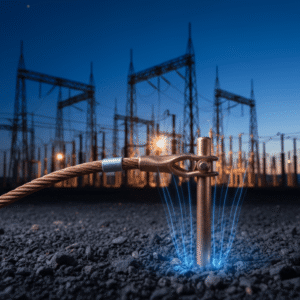
Lightning Protection & Surge Suppression
Multi-Layered Defense: Certified Lightning Protection & Transient Surge Suppression
I. The Catastrophic Threat of Transients
The velocity and magnitude of transient energy render traditional circuit breakers ineffective. We specialize in protecting against both external and internal threats.
- External Threats (Lightning): Direct or indirect lightning strikes can inject current measured in the hundreds of thousands of amperes into your facility’s grounding system and power lines, requiring a massive, dedicated defense system.
- Utility Switching Surges: High-magnitude, repetitive surges occur when the utility company switches capacitor banks or re-energizes lines, causing cumulative stress and damage to sensitive equipment over time.
- Internal Transients: Your facility itself is a source of transients. Switching large inductive loads (motors, transformers, welding equipment) creates internal voltage spikes that can instantly destroy nearby electronic controls, PLCs, and VFDs.
II. Methodology: Coordinated, Standards-Based Protection
Effective protection requires a coordinated, three-stage strategy. Our designs adhere to the strictest Canadian and international standards, ensuring comprehensive, insurable defense.
Key Standards and Compliance:
- NFPA 780: Standard for the Installation of Lightning Protection Systems (LPS). We ensure external protection methods meet this stringent requirement.
- UL 1449 (4th Edition): Standard for Surge Protective Devices (SPD). We exclusively use devices verified by this standard for proven safety and performance.
- IEEE C62 Series: Guiding standards for surge protection design and testing in AC power circuits.
- CEC / OESC: All installations comply with the Canadian Electrical Code and the Ontario Electrical Safety Code requirements for bonding and grounding.
III. The Three Stages of Protection (SPDs)
We implement a layered defense using Surge Protective Devices (SPDs) at every critical zone to safely divert destructive energy to the ground.
| SPD Stage | Location & Function | Technical Focus |
|---|---|---|
| Stage 1 (Category C) | Service Entrance / Main Disconnect: Primary defense against massive external surges (e.g., lightning, utility faults). Drains the bulk of the transient energy. | High Nominal Discharge Current (In) and Maximum Continuous Operating Voltage (MCOV). |
| Stage 2 (Category B) | Distribution Panels / Sub-Panels: Secondary defense, managing residual surges and larger internally generated transients. Protects groups of critical loads. | Optimal Voltage Protection Rating (VPR) to ensure a low let-through voltage. |
| Stage 3 (Category A) | Point-of-Use: Tertiary defense directly protecting sensitive equipment (IT servers, PLCs, instrumentation, CNC machinery). | Ultra-fast Response Time and the lowest possible Clamping Voltage for micro-sensitive assets. |
IV. External Lightning Protection (LPS)
For structures requiring defense against direct lightning strikes, we design and install certified External Lightning Protection Systems (LPS) compliant with NFPA 780.
- Protection Principle: We use the Rolling Sphere Method to determine the optimal placement of air terminals (lightning rods) and down conductors.
- Goal: Safely intercept the lightning strike and route the massive energy (measured in kiloamperes) directly to a dedicated, low-impedance grounding system, bypassing the structure and electrical system entirely.
- Coordinated Grounding: The LPS must be bonded and connected to a certified, low-resistance grounding system to ensure safe and effective energy dissipation into the earth.
V. Measurable Value and Expert Conclusion
Investing in certified transient protection is the ultimate insurance policy for your operational continuity and capital equipment. We guarantee a defense system built to withstand the worst-case scenario.
- Zero Tolerance for Failure: By preventing transient damage, we eliminate emergency equipment failure and ensure maximum uptime for sensitive production lines and IT infrastructure.
- Extended Equipment Lifespan: Chronic exposure to smaller transients (internal switching) degrades electronic components over time. Our layered system filters this energy, dramatically extending the life of costly VFDs, power supplies, and control boards.
- Verified and Insurable Defense: All systems are designed by certified electrical engineers, installed to code, and utilize UL 1449 certified devices, providing you with an audit-ready, insurable defense system.
Don’t leave your most critical assets exposed to sudden, catastrophic failure. Smart Power Solutions provides the engineering expertise to design and implement a coordinated protection strategy that works. Contact us today for an assessment of your transient vulnerability and secure your operational future.
Contact Us
To get a quote
To get a solution
To ask a technical question