
Harmonic Distortion Analysis Ontario: Industrial THD Testing, IEEE 519 Evaluation & Power Quality Diagnostics
Industrial facilities across Ontario increasingly depend on non-linear electrical loads such as variable frequency drives (VFDs), robotics, rectifiers, high-frequency welders, UPS systems, automated packaging lines, and switch-mode power supplies. While these technologies increase efficiency and production control, they also introduce harmonic currents that distort the electrical waveform. A structured harmonic distortion analysis Ontario provides measurable data to identify distortion levels, determine risk exposure, and implement targeted mitigation strategies before equipment damage or downtime occurs.
Harmonics are not theoretical problems. In manufacturing environments, they lead to transformer overheating harmonics conditions, neutral overheating due to harmonics, unexplained breaker trips, capacitor failures, and accelerated insulation degradation. Facilities often discover these issues only after repeated maintenance events or thermal alarms. A professional industrial harmonic testing program eliminates guesswork and replaces it with documented electrical evidence.
If you are evaluating overall electrical reliability, begin with our core service:
Power Quality Diagnostics & Testing.
Understanding Harmonic Distortion in Industrial Power Systems
In a linear electrical system, current follows voltage in a smooth sinusoidal pattern at 60 Hz. However, non-linear loads draw current in pulses. These pulses create harmonic components at multiples of the fundamental frequency. These harmonic currents interact with system impedance, producing voltage distortion that propagates throughout the distribution network.
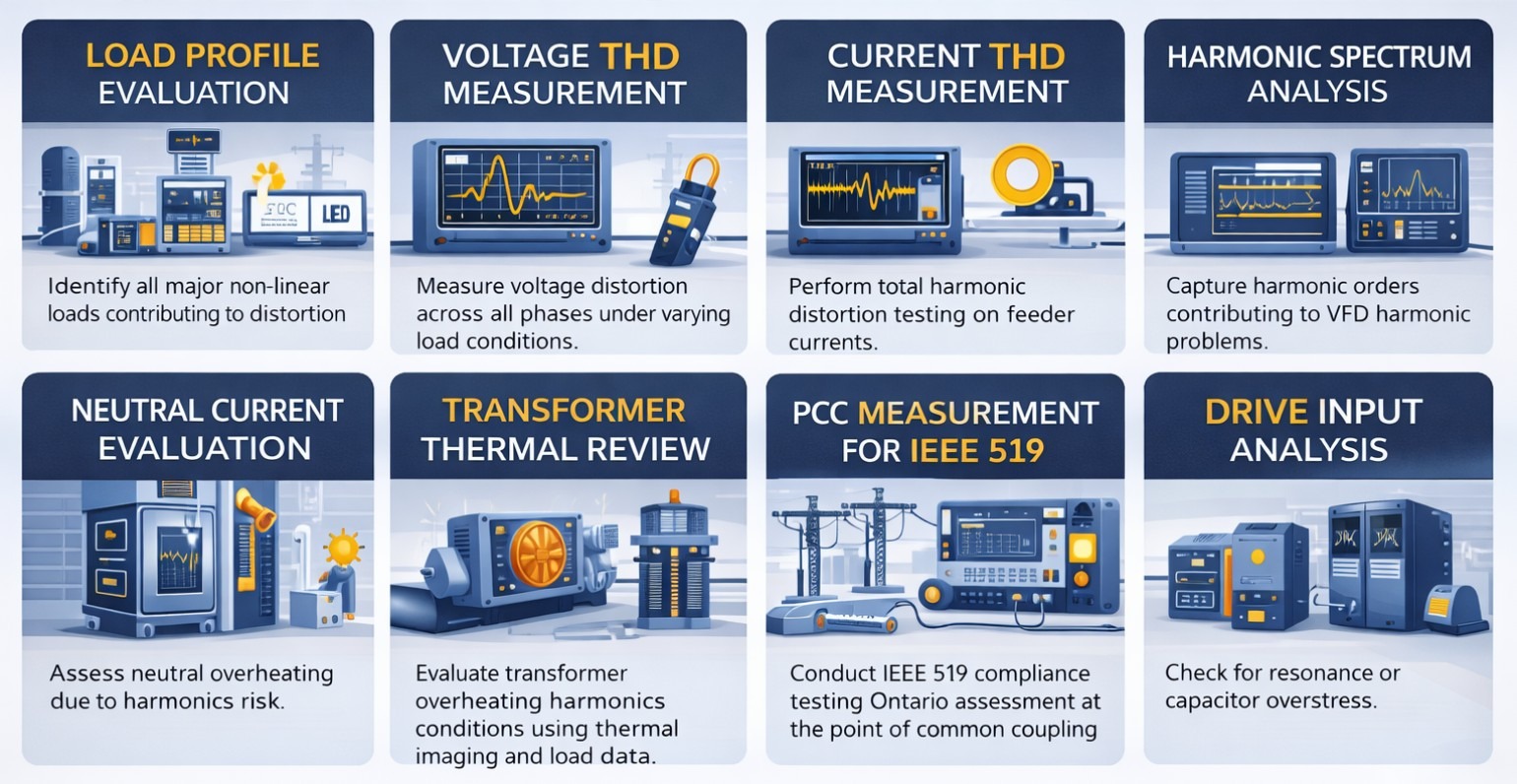
A professional power quality harmonic analysis measures both current distortion and voltage distortion under real operating conditions. Total harmonic distortion testing (THD testing industrial environments rely on) expresses harmonic content as a percentage of the fundamental waveform. Current THD affects heating and losses, while voltage THD impacts sensitive electronics and control systems.
As facilities expand automation and electrification, harmonic contribution increases. Without periodic THD testing industrial facilities risk operating with distortion levels that gradually compromise reliability.
Operational Risks Associated with Harmonics
Harmonic distortion produces measurable physical effects in industrial electrical systems:
- Increased eddy current losses in transformers
- Elevated conductor heating
- Reduced insulation lifespan
- Capacitor resonance conditions
- Breaker nuisance tripping
- Voltage waveform distortion affecting PLCs and drives
Facilities experiencing VFD harmonic problems industrial environments often misinterpret these symptoms as random electrical faults. Only structured power quality diagnostics Ontario can isolate harmonics as the root cause.
One of the most common findings during harmonic distortion analysis Ontario is excessive heating in transformer windings despite normal kW loading. This occurs because harmonic currents increase RMS current and thermal losses without increasing productive power.
Neutral and Transformer Stress Mechanisms
Neutral Conductor Stress
Triplen harmonics (3rd, 9th, 15th, etc.) sum in the neutral of three-phase systems. Even when phase currents appear balanced, neutral overheating due to harmonics can occur. This condition often remains hidden until termination points show discoloration or insulation deterioration.
Transformer Thermal Loading
Transformer overheating harmonics results from additional core and stray losses. Standard transformers are designed primarily for fundamental frequency operation. Harmonic currents increase heating disproportionately, reducing long-term lifespan.
Thermal stress caused by harmonic currents is often visible long before electrical failure occurs. Infrared inspection can reveal abnormal heating patterns in transformers, neutrals, breakers, and bus connections. Facilities experiencing elevated temperatures should consider a
Thermal Infrared Electrical Audit
to detect early-stage overheating linked to harmonic distortion.
How Industrial Harmonic Testing Is Conducted
Effective industrial harmonic testing requires strategic measurement planning. Testing should reflect actual production conditions rather than idle states.
Measurement Locations
Monitoring is typically conducted at:
- Main service entrance
- Point of common coupling (for IEEE 519 compliance testing Ontario)
- Major distribution panels
- Load groups with high VFD density
Instrumentation
Power quality analyzer testing requires Class A analyzers capable of capturing harmonic spectrum, RMS values, voltage THD, current THD, and demand trends over extended monitoring periods.
Harmonic Spectrum Evaluation
Identifying dominant harmonic orders supports targeted mitigation. Some facilities exhibit dominant 5th and 7th harmonics due to six-pulse drives, while others show broader spectral distortion.
Load Correlation
Distortion levels often vary with production load. Proper power quality harmonic analysis includes correlation with operating cycles to determine peak distortion windows.
IEEE 519 Evaluation
IEEE 519 compliance testing Ontario assesses harmonic current injection at the PCC relative to short-circuit capacity. While not always mandatory, IEEE 519 provides an industry benchmark.
Reference:
IEEE 519 Standard Overview
Evaluation against IEEE 519 supports structured reporting and provides documented thresholds for mitigation planning.
Typical Harmonic Sources in Ontario Facilities
- High concentrations of VFD-driven motors
- Robotic welding stations
- Large UPS installations
- Battery charging infrastructure
- LED lighting retrofits
- Data processing equipment
A thorough harmonic distortion analysis Ontario identifies cumulative distortion impact from combined non-linear sources.
Mitigation Strategies Based on Measured Data
Mitigation must be data-driven. Common harmonic mitigation solutions Ontario facilities consider include:
Passive Harmonic Filters
Target specific harmonic frequencies. Effective when dominant harmonics are stable.
Active Harmonic Filters
Dynamically compensate harmonic currents under varying load conditions.
Line Reactors
Reduce distortion at drive inputs and improve system stability.
K-Rated Transformers
Designed to tolerate harmonic heating effects.
Load Distribution Adjustments
Balancing non-linear loads across transformers reduces localized stress.
Facilities operating capacitor banks for power factor improvement must evaluate harmonic interaction carefully. In high distortion environments, improper capacitor sizing may amplify harmonic resonance. A combined review of harmonic levels and
Power Factor Correction
strategy ensures both improved efficiency and stable system operation.
Integration with Broader Power Quality Diagnostics
Harmonics frequently coexist with other disturbances. Facilities experiencing voltage dips should review:
Voltage Sag Investigation Ontario.
Comprehensive diagnostics are available here:
Power Quality Diagnostics & Testing.
Business Case for Harmonic Testing
Ignoring harmonics increases operational cost. Preventive industrial harmonic testing reduces downtime, extends transformer lifespan, improves system efficiency, and minimizes emergency repairs.
Harmonic distortion does not only affect reliability — it also impacts efficiency. Increased RMS current and additional heating losses reduce system efficiency and increase operational costs. Facilities focused on reducing energy waste should also consider a structured
Energy Efficiency Audit
to quantify avoidable losses related to harmonic distortion and non-linear loading.
Facilities investing in structured power quality diagnostics Ontario programs often prevent premature capital expenditure and improve long-term reliability.
Frequently Asked Questions
What is harmonic distortion?
Harmonic distortion refers to waveform components at multiples of 60 Hz caused by non-linear loads.
What is THD?
Total harmonic distortion testing measures harmonic magnitude relative to the fundamental waveform.
When should harmonic testing be performed?
After major VFD installations, repeated overheating events, or unexplained electrical failures.
Does IEEE 519 apply to all facilities?
IEEE 519 provides recommended harmonic limits; applicability depends on system configuration and utility requirements.
Can harmonics cause transformer failure?
Yes. Transformer overheating harmonics increase thermal stress and reduce insulation life.
Why do neutrals overheat?
Triplen harmonics accumulate in neutral conductors, causing neutral overheating due to harmonics.
Are harmonics only caused by VFDs?
No. UPS systems, welders, rectifiers, and LED drivers also contribute.
How long does testing take?
Monitoring typically runs several days to capture representative load conditions.
Can filters eliminate all distortion?
No system eliminates all harmonics, but properly designed mitigation reduces distortion to safe levels.
What is the next step?
Schedule a consultation:
Contact Smart Power Solutions.
Contact Us
To get a quote
To get a solution
To ask a technical question