
Voltage Sag Investigation Ontario: Stop Equipment Trips, PLC Resets & Production Downtime
Unexpected production stops can feel random, but in most industrial facilities they follow a pattern. If your line trips, drives fault, contactors drop out, or PLCs reboot—and there is no breaker trip or obvious damage—your site may be experiencing voltage sags. A structured voltage sag investigation Ontario turns these “mystery” events into measured evidence and a practical plan to reduce downtime.
This guide is designed for Ontario plant managers, facility owners, maintenance teams, and engineers who need clear answers. It explains what voltage sags are, why modern equipment is sensitive, how an industrial voltage dip analysis is performed, how to identify the origin of events, and what mitigation options actually work. If you want the full diagnostic service scope, start here: full power quality diagnostics service.
We will use real-world language because that’s how problems show up on the floor: production equipment tripping, PLC reset power disturbance, and machinery shutdown power issue. These are not “theories”—they are operational symptoms that typically have an electrical signature, especially when events are short and intermittent.
What Is a Voltage Sag?
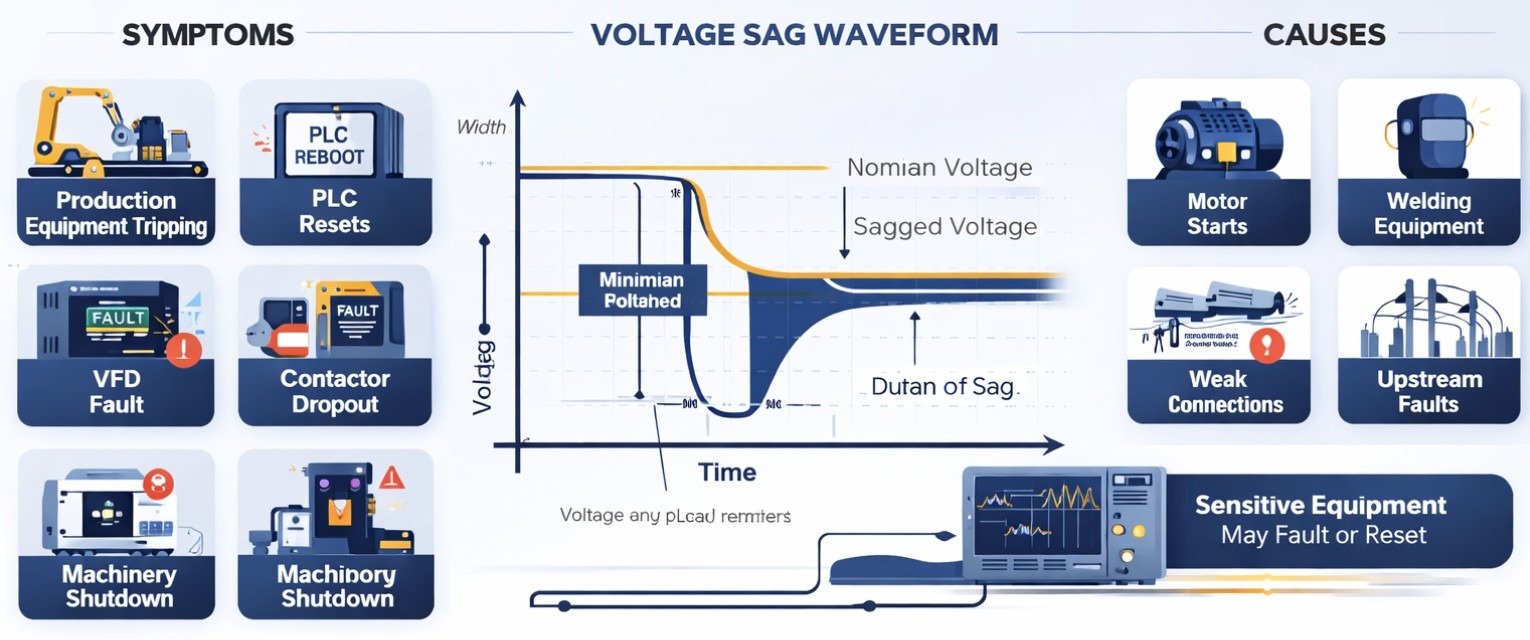
A voltage sag (often called a “dip”) is a short, temporary reduction in RMS voltage. It can last from a few milliseconds to several seconds. Even when power returns quickly, the effect on sensitive electronics can be immediate: a PLC may reboot, an HMI may restart, a VFD may fault, and production may halt.
Because sags are brief, basic meters often miss them. That is why momentary power failure diagnostics must use event capture with proper triggers, timestamps, and waveform storage. A professional power disturbance investigation in Ontario is built around that capability.
When the same kind of event repeats—especially during particular operating conditions—the facility needs structured measurement rather than guesswork. The purpose of a facility voltage event assessment is to explain what happened, how often it happens, where it starts, and what changes will prevent downtime.
Symptoms That Suggest Voltage Sags (Not Random Failures)
Facilities rarely begin by saying “we have voltage sags.” They begin with symptoms. If you see any of the issues below, a power quality event investigation should be considered.
- Production equipment tripping without overloads or breaker trips
- PLC reset power disturbance events (PLC reboot, HMI restart, network switch reset)
- VFD faults (undervoltage, DC bus undervoltage, ride-through alarms)
- Contactor dropouts and relay release events
- Robotics or CNC losing state, stopping mid-cycle
- Events that are intermittent and hard to reproduce
- Line stops that correlate with compressor cycling or large motor starts
Most sites describe the outcome as a machinery shutdown power issue. The challenge is capturing the electrical event at the moment it occurs. That is exactly what an industrial voltage dip analysis is designed to do.
Why Basic Monitoring Misses Voltage Sags
Standard monitoring often shows “everything looks normal” because it trends averages. Many panel meters display voltage updates slowly and do not store waveforms. Building automation systems typically log at long intervals. So the facility keeps doing voltage drop troubleshooting Toronto with incomplete evidence.
Effective momentary power failure diagnostics usually require:
- Event triggers by magnitude and duration (sag thresholds)
- Waveform recording with adequate sampling
- Accurate timestamps (to correlate across locations)
- Simultaneous voltage and current channels
- Event classification: magnitude, duration, phases involved
Without these capabilities, a site may replace parts repeatedly without eliminating the root cause. A voltage sag investigation Ontario avoids that waste by proving the event profile and origin.
7 Critical Causes of Voltage Sags in Industrial Facilities
Voltage sags can originate inside the facility or arrive from upstream supply. The same symptom (a trip or reset) may have different causes. A site power disturbance assessment identifies which applies to your site.
1) Large motor starts and inrush current
Compressor starts, pumps, dust collection, and large fans can pull high inrush current. The resulting voltage dip can cross the ride-through limit of controls, producing PLC reset power disturbance events and production equipment tripping.
2) Welding loads and cyclic industrial equipment
Welders and cyclic loads create rapid current changes. These can create repeated dips that are invisible to slow meters but obvious in industrial voltage dip analysis.
3) Weak connections and increased impedance
Loose lugs, worn contacts, degraded conductors, or damaged terminations can increase impedance. During load changes, voltage drops become deeper than expected and intermittent—classic machinery shutdown power issue conditions.
4) Undersized transformer or long feeder runs
If the distribution is marginal, dips can be exaggerated downstream under normal load swings. A facility voltage disturbance review often reveals that the service is stable but the local distribution is not.
5) Internal switching events
Capacitor switching, contactor transitions, and certain control logic sequences can trigger short events that appear as short duration voltage interruption signatures to sensitive equipment.
6) Upstream faults and protection clearing
Faults on the feeder or upstream switching can create sags that affect many customers. These are frequently misread as “random.” Evidence from momentary power failure diagnostics shows whether the sag is visible at the service entrance.
7) Neighboring high-demand customers
Large disturbances from nearby operations can influence local voltage on shared infrastructure. A power quality disturbance investigation helps determine if events are broader than your site.
How a Voltage Sag Investigation Ontario Is Done (Step-by-Step)
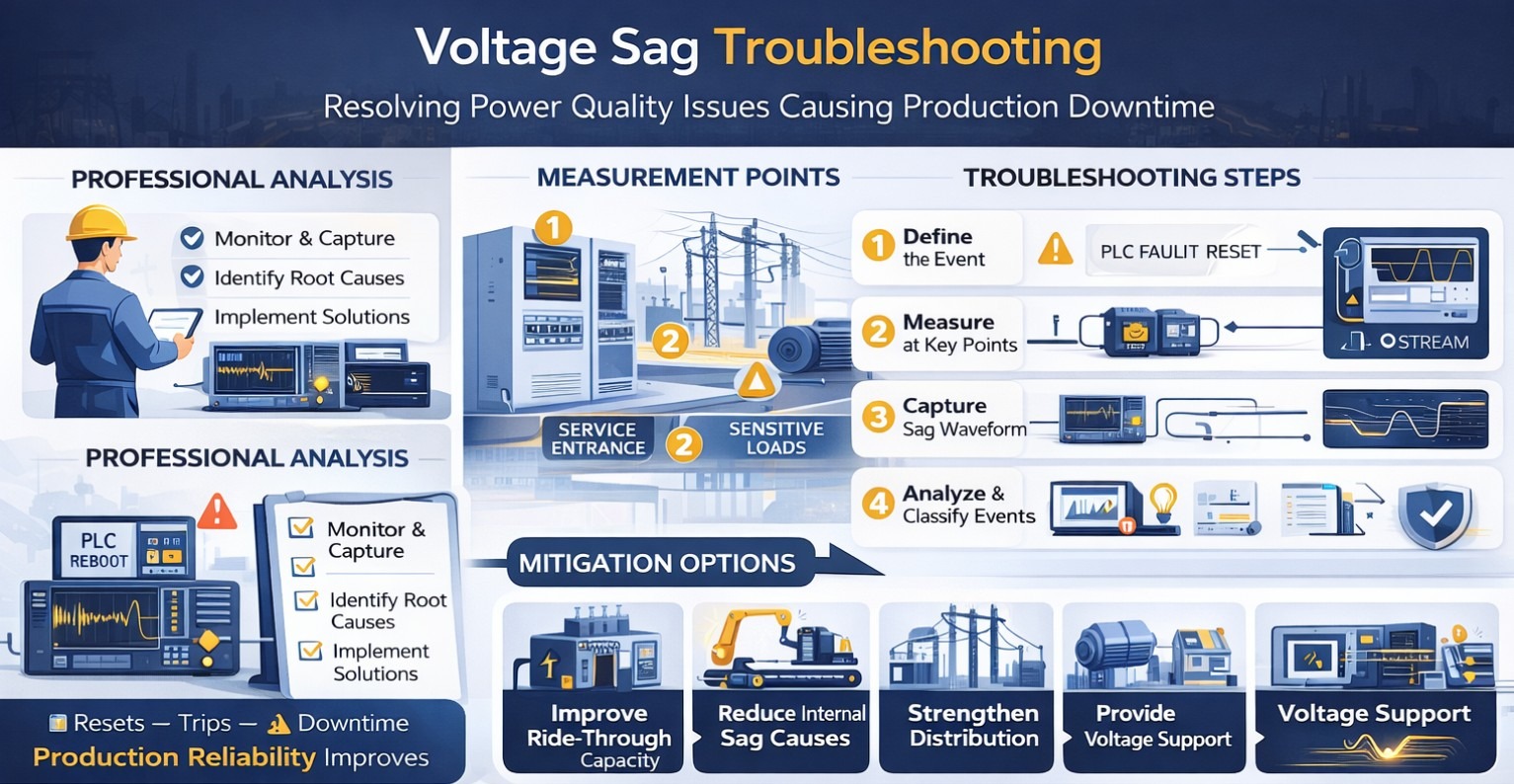
A professional voltage sag investigation Ontario is not “install a logger and hope.” It is a structured plan designed to answer four questions: what happened, how often, where it starts, and how to stop it.
Step 1 — Define the operational event
We document the exact symptom: what stopped first, what fault codes appeared, and what else was running. This prevents mixing unrelated events into the same “bucket” and strengthens electrical disturbance root cause analysis.
Step 2 — Choose measurement points
To determine origin, we often measure at the service entrance and near affected loads. Comparing upstream vs downstream is critical to a defensible power disturbance investigation in Ontario conclusion. It also helps resolve utility-vs-internal debates during voltage drop troubleshooting Toronto.
Step 3 — Configure triggers and event capture
We set triggers based on sag magnitude and duration, and we ensure time alignment across channels. Correct triggers reduce noise and ensure the events that cause production equipment tripping are captured clearly.
Step 4 — Monitor through representative operating cycles
Many investigations require 7–14 days, depending on event frequency. During monitoring, the team logs symptoms—especially PLC reset power disturbance events—so we can correlate electrical data to operations.
Step 5 — Analyze and classify events
This is where industrial voltage dip analysis becomes useful: we classify events by magnitude, duration, and phase involvement, and compare timing across locations. This forms the core of electrical disturbance root cause analysis.
Step 6 — Deliver mitigation options and a verification plan
The output is a ranked mitigation plan. The site then verifies improvements with follow-up monitoring. A complete facility voltage event assessment includes that loop—otherwise the facility may spend money and still face machinery shutdown power issue symptoms.
If you want end-to-end support, start with our main service: comprehensive electrical system assessment.
Internal vs Upstream: How to Tell Where the Sag Starts
The “source question” is the biggest one. Many sites assume upstream supply issues, but many sags are internal. A site power disturbance assessment answers this using comparisons and timing.
Signs the sag is internal
- Sags align with motor starts, compressors, welding cycles, or internal switching
- Sags are deeper downstream than at the service entrance
- Only a section of the facility is affected
- Current signatures show local inrush or step changes
Signs the sag is upstream
- The sag appears at the service entrance and across multiple panels simultaneously
- Events affect multiple phases in patterns typical of feeder disturbances
- Neighbors report similar issues at the same time
- Events correlate with storms or known switching activity
This is why a two-point measurement strategy is so important. It turns subjective voltage drop troubleshooting Toronto into objective, timestamped evidence and strengthens electrical disturbance root cause analysis.
Why Magnitude and Duration Matter
Not every sag causes a stop. The impact depends on magnitude, duration, phase involvement, and equipment tolerance. Two sags can look similar on a slow meter, but one can trip a drive while the other does nothing.
In a power disturbance investigation in Ontario, we focus on:
- Minimum voltage reached during the event
- Event duration (cycles/milliseconds)
- One-phase vs three-phase involvement
- Associated current behavior (inrush, step changes)
- Correlation with symptoms (trips, resets)
Capturing the right parameters is part of momentary power failure diagnostics and essential for evaluating short duration voltage interruption events that are otherwise invisible.
Why Controls and PLCs Reset First
Many plants discover that motors could have continued, but controls drop out first. PLC power supplies, network switches, and safety relays often have tighter ride-through limits. This is why PLC reset power disturbance events are one of the most common operational symptoms.
For many sites, improving control power ride-through becomes the fastest first mitigation—especially when the measured sag is not extreme but still crosses the control tolerance threshold. A facility voltage disturbance review identifies that threshold and validates solutions.
Mitigation Options (What Works in the Real World)
Once you have measured evidence, mitigation becomes far more effective. Without a power quality event investigation, sites often buy equipment blindly and still experience production equipment tripping.
1) Improve control power ride-through
DC UPS modules for controls, better PLC power supplies, and ride-through support for critical relays can eliminate many PLC reset power disturbance events even if sags still occur.
2) Reduce internal sag severity (if internal cause is confirmed)
Soft starters, tuned VFD ramps, staged load sequencing, and separation of cyclic loads can reduce sag depth and frequency. This is often validated through industrial voltage dip analysis.
3) Strengthen distribution and correct weak points
Fixing degraded connections, improving feeder sizing, and correcting distribution layout can prevent deep dips under load change—often the root of a machinery shutdown power issue.
4) Targeted voltage support for critical sections
For severe and frequent events, specialized solutions may be justified for critical loads. Selection should follow electrical disturbance root cause analysis and downtime-cost evaluation.
5) Verification monitoring
After mitigation, follow-up event capture confirms that short duration voltage interruption events no longer cross the vulnerability threshold. This closes the loop on a facility voltage event assessment.
What You Should Receive (Deliverables)
A strong report should be decision-ready. A professional site power disturbance assessment deliverable typically includes:
- Executive summary: what happened and what to do next
- Event table: timestamps, magnitude, duration, phases involved
- Waveform examples and interpretation notes
- Origin evidence: upstream vs internal comparisons
- Impact summary and risk ranking
- Ranked mitigation options (effectiveness + complexity)
- Verification plan to confirm results
This becomes a management-ready manufacturing power reliability assessment rather than a raw data export.
Reference Standard
For background on monitoring and event classification, IEEE provides a widely referenced recommended practice. External reference (DoFollow):
IEEE 1159 – Recommended Practice for Monitoring Electric Power Quality.
This reference supports consistent terminology used during momentary power failure diagnostics and helps align a power disturbance investigation in Ontario with recognized monitoring practice.
Why Solving Voltage Sags Pays Back Fast
The sag itself is short. The cost is not. The real cost is downtime, restart time, scrap, and repeated maintenance hours. If production equipment tripping happens even a few times per month, a measured solution often pays for itself quickly.
- Unplanned downtime and lost production time
- Scrap and rework from interrupted cycles
- Accelerated wear on drives and electronics
- Labor hours spent on repeated troubleshooting
- Quality and safety risk during sudden stops
A complete facility voltage disturbance review provides evidence that supports the correct mitigation decision and prevents wasted spend.
FAQ
How long does monitoring take?
Many sites require 7–14 days to capture representative events. If events are rare, monitoring can be extended to ensure electrical disturbance root cause analysis is confident and repeatable.
Can sags happen without a breaker trip?
Yes. Many sag events do not trip protective devices but still cause resets and trips due to equipment ride-through limits. That’s why momentary power failure diagnostics must capture short events and correlate them with operations.
Is the utility always responsible?
No. Many sags are internal. A site power disturbance assessment compares service entrance and downstream data to determine origin and guide the right mitigation strategy.
What is the fastest first mitigation?
Improving control power ride-through is often the quickest way to reduce PLC reset power disturbance and line stops. However, the best approach depends on measured sag characteristics from industrial voltage dip analysis.
Next Steps
If your facility is experiencing repeated resets, trips, or unexplained stops, you don’t need guesses—you need measured evidence and a ranked plan. A structured voltage sag investigation Ontario delivers event capture, origin proof, and practical mitigation.
Start with our main service: Power Quality Diagnostics & Testing
Contact us: Contact Smart Power Solutions
Contact Us
To get a quote
To get a solution
To ask a technical question